
Den Sai offers a different encounter with Hanoi’s history from a central-city monument. Here, the story of building Co Loa survives in a hilltop shrine and in Thuy Loi village’s remarkable king procession. The important planning choice is whether you want to see the sacred site on an ordinary day or attend the annual festival.
Den Sai is in the Thuy Loi area of Thu Lam commune, north of central Hanoi. Older references say Thuy Lam, Dong Anh. Allow approximately an hour for a focused ordinary visit, plus road travel; a festival outing needs a more flexible half day or longer. There is no daily king procession included in an ordinary temple visit.
Understand the names before setting off
Use the map search Den Sai, Thuy Loi, and save the actual entrance pin. Sai hill belongs to the landscape known as That Dieu Son. The area contains several religious buildings, so a driver stopping at a communal house has not necessarily delivered you to the hilltop shrine you intended to visit.

Den Sai honors Huyen Thien Tran Vu. Nearby Den Thuong honors Cao Son, while the Buddhist site behind Den Sai is described by the National Museum of History as Chua Thich Ca. Thuy Loi communal house has its own role in village ceremonies. These names represent distinct places within the wider cultural area, not interchangeable labels for one altar.
For a first visit, make Den Sai the priority and add only the buildings that are open and practical on the day. A long list of shrine names is less useful than knowing why you are going and where your return vehicle will meet you.
The Co Loa connection is a legend to understand
The shrine’s story concerns An Duong Vuong’s difficulty constructing Co Loa. In local tradition, a supernatural white-cockerel spirit obstructs the work, and divine assistance enables the king to overcome it. Den Sai’s worship and festival preserve this narrative.
The story is not the same kind of evidence as excavated earthworks or bronze casting remains. If visiting Co Loa Citadel as well, keep the distinction clear: archaeology helps explain the fortified settlement, while Den Sai shows how communities remember the king through belief and ceremony.
Huyen Thien Tran Vu is also the deity associated with Hanoi’s Quan Thanh Temple. That connection can help a visitor recognize the broader religious tradition, but Den Sai is a separate village setting rather than another entrance to the West Lake shrine.
What to look for during an ordinary visit
Begin with the approach up the hill and the gateway. The museum describes a gate with three principal openings and two subsidiary openings, a bell pavilion, and the distinctive Kinh Thien pavilion. The latter houses an inscribed stone pillar known as Huyen Thien Dao Quan.
Make the pavilion and inscription a deliberate pause. Look at how the roof protects the stone and how the object sits within the sequence of worship spaces. A guide’s short explanation of the inscription’s purpose is more useful than trying to decipher worn characters in a rushed photograph.
The principal deity’s image is described as a painted and gilded earthen statue, with turtle and snake imagery around the base. View it only from the permitted position. Do not assume the sanctuary is an unrestricted exhibition room or that every object described in a historic study is always on public display.
Several structures have been restored. Religious continuity does not mean that all visible timber, roof tiles or paint belong to the earliest period associated with the shrine. Notice the relationship between old objects, renewed buildings and current worship instead of treating restoration as proof that the place has no history.
The king procession: when and how to plan
The principal festival is associated with the eleventh day of the first lunar month. Community members take ceremonial roles as king, lord and officials, and the procession recalls the village’s responsibility to perform rites connected with the Co Loa legend.
The symbolic defeat of the white-cockerel spirit is part of the ritual narrative. The participants are members of a living community carrying out a traditional observance, not costumed performers waiting for a tourist audience. Let the procession move and follow the organizers’ directions about where visitors may stand.
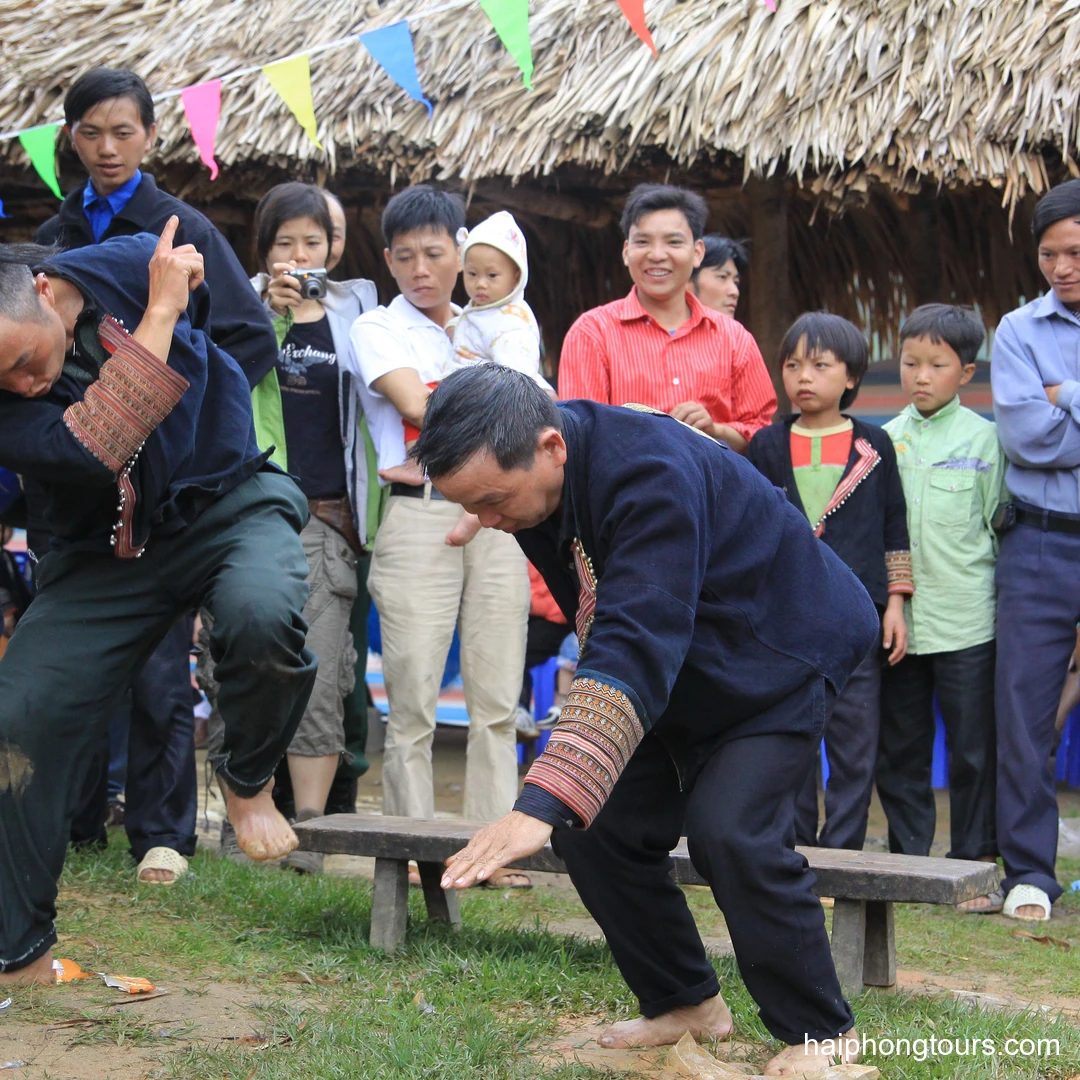
Use the current local festival program to establish the main day, procession route and any surrounding activities. A lunar date alone does not tell you the hour when a particular ceremony begins. A previous year’s wrestling, music or procession schedule should not be copied into a new booking.
For a festival visit, agree on a meeting point outside the busiest approach, keep your group together and allow time to walk from parking. With children, choose a viewing position where you can step away easily. Do not climb a wall, stone object or ritual platform to see above the crowd.
Transport: book the return, not only the outward ride
From central Hanoi, an arranged car suits visitors who want a predictable return and one carefully chosen companion stop. Specify Den Sai at Thuy Loi, the number of passengers and whether your booking includes waiting. A one-way drop-off does not provide a car after the temple visit.
For independent public transport, establish the current bus connections and final approach from your actual starting point before departure. This guide does not name an unverified direct tourist bus or promise a vehicle will be available at the entrance. If the last section cannot be arranged confidently, choose a return car instead of improvising after arrival.
Keep large luggage out of the temple route. If visiting between hotels, establish secure luggage handling with the transport provider and avoid leaving valuables unattended. The hilltop setting and ceremonial approaches are a poor place to wheel a suitcase.
Choose one companion experience
Co Loa for history: use a focused central-cluster visit at the citadel, then Den Sai to explore the ritual side of the king’s story. A full earthwork circuit plus every nearby shrine would create an unnecessarily long day. Allow a separate lunch and both road journeys.
Dao Thuc for living performance: the Dao Thuc water-puppet village guide explains the need to arrange a performance with the troupe. A visit to Den Sai does not include a puppet show. Make the confirmed show time the fixed point, then place the flexible temple stop around it.
Do not combine both extensions simply because they appear in the same promotional itinerary. Choose Co Loa if early-state history is your priority, or Dao Thuc if the craft and performance matter more. A meaningful conversation or explanation needs space in the schedule.
Access, water and respectful visiting
Expect a hill approach, changes of level and temple thresholds rather than a fully level museum route. During rain, shorten the outing if the surfaces become slippery. Travelers needing step-free access should request current entrance-route information before booking; the site’s small scale does not establish wheelchair suitability.
The local sacred-well tradition should not be confused with a guarantee of drinking-water quality. Bring your own drinking water and observe any ritual without assuming water from a natural or ceremonial source is suitable to drink.
Wear modest clothing, keep clear of worshippers and ask before photographing altar interiors or ceremonies. There is no verified ordinary daily timetable or admission tariff in the primary material used here, so arrange daylight access locally and separate any parking or guiding charge from voluntary offerings. Festival trading does not guarantee the same food choices on a quiet weekday; plan a meal in advance if combining sites.

Would you like to combine Den Sai with Co Loa or a prearranged Dao Thuc performance? Contact Hai Phong Tours with your date, hotel and main interest so we can help assess transport and a realistic sequence.