
Ninh Binh’s most useful festival period runs from Lunar New Year through the third lunar month. Bái Đính opens its spring festival on the sixth day of the new year, while Hoa Lư, Thái Vi and Tràng An usually follow several weeks later. Phát Diệm Cathedral offers a different major gathering at Christmas.
Lunar dates move against the international calendar, and organizers can adjust the program each year. Use the dates below to choose a festival, then check the official announcement for the exact Gregorian date, ceremony location and traffic plan before booking transport. These five events take place in the historic Ninh Binh destination area within today’s larger Ninh Binh Province.
Ninh Binh festival calendar at a glance
- Bái Đính Pagoda Festival: opening ceremony on the sixth day of the first lunar month; the pagoda remains busy through the spring pilgrimage season.
- Hoa Lư Festival: currently organized around the ninth to eleventh days of the third lunar month at the ancient-capital complex.
- Thái Vi Temple Festival: the fifteenth day of the third lunar month is the traditional main day, with activities beginning around the previous day.
- Tràng An Festival: centered around the eighteenth day of the third lunar month; the program may span two days.
- Christmas at Phát Diệm Cathedral: the evening of December 24 and Christmas Day, with related music or parish events announced separately.
The first four dates use the Vietnamese lunar calendar. Do not convert them by simply adding a fixed number of weeks to January: Lunar New Year changes each year, and the third lunar month can fall in April or May.
1. Bái Đính Pagoda Festival
The Bái Đính spring festival is the easiest choice for travelers already visiting the large pagoda complex soon after Lunar New Year. The formal opening is normally held on the sixth day of the first lunar month. It marks the beginning of a longer pilgrimage season rather than a single afternoon of performances.
Bái Đính combines the old pagoda area with an extensive newer Buddhist complex. The long walking distances, steps and optional electric-car sections matter more to most visitors than the record claims often used to promote the site. Decide whether your priority is the opening ceremony, worship or a quieter architectural visit.
Practical plan
- Expect the heaviest traffic and longest waits around the opening day and early spring weekends.
- Arrive early, agree on a driver meeting point and save it offline before joining the crowd.
- Allow several hours if you want both the old and new pagoda areas.
- Ask which electric-car stages are operating and what each ticket covers before paying.
- Wear clothing that covers shoulders and knees, keep worship routes clear and follow any one-way crowd controls.
Best for: travelers who want a large spring pilgrimage atmosphere and can manage crowds and a long site visit. Choose a normal weekday later in spring when architecture matters more than the opening ceremony.
2. Hoa Lư Festival
Hoa Lư Festival commemorates the rulers and people connected with the 10th-century capital and the Đinh–Early Lê period. The program can include a water procession, incense offerings, palanquin processions, traditional rites, performances, exhibitions and folk games across the ancient-capital area.
Do not rely on the old sixth-to-eighth-day schedule. The 2026 festival took place from the ninth to eleventh days of the third lunar month, and current provincial material describes that as the annual period. Check the new announcement each year because the opening program and individual ceremonies have their own times and locations.
Practical plan
- Choose the specific ceremony or performance you want instead of arriving with only a three-day date range.
- Expect road controls, temporary parking and slower access around the main opening.
- Use sun protection and carry water; the festival space extends beyond one temple courtyard.
- Keep distance from processions and do not cross between ritual participants.
- Allow a half-day for the main heritage area, longer when following several scheduled activities.
Best for: visitors interested in the history of the ancient capital and a program that combines formal ritual with public cultural activities.
3. Thái Vi Temple Festival
Thái Vi Temple is associated with the early Trần kings and the Vũ Lâm base used during resistance to the Mongol–Yuan invasions. The festival is a community event with incense offerings, traditional rites, processions, music and folk competitions. It takes place near the Tam Cốc visitor area, but the temple and boat pier are distinct stops.
The fifteenth day of the third lunar month is the traditional annual festival day. In 2026, preliminary rites and activities began on the fourteenth day, followed by the main opening on the fifteenth. The old claim that the festival happens only once every three years is unsafe for current planning.

Practical plan
- Confirm whether the event you want is at Thái Vi Temple, the Tam Cốc boat area or along a procession route.
- Do not assume a normal Tam Cốc boat ticket includes festival seating, transport or access to a ceremony.
- Allow extra time for the narrow local roads and pedestrian movement around Văn Lâm.
- Ask before photographing ritual participants, especially during offerings and processions.
- Combine the festival with Tam Cốc only when crowd and boat timings leave a comfortable margin.
Best for: travelers staying near Tam Cốc who want a locally rooted temple festival on a more compact scale than Bái Đính.
For a visit outside the festival, the Thai Vi Temple visitor guide explains the carved stonework, local transport and what to ask about a temple-only ticket.
4. Tràng An Festival
Tràng An Festival honors Quý Minh Đại Vương, the Trần kings and earlier figures remembered in the area’s spiritual traditions. The event is closely connected with the karst landscape and waterways, and its program may include ceremonies on land and water.
The festival is associated with the eighteenth day of the third lunar month. The 2026 program ran on the seventeenth and eighteenth days, with the opening on the seventeenth. Treat the eighteenth as the traditional anchor, then use the annual program to determine which day contains the procession or activity you want.
Practical plan
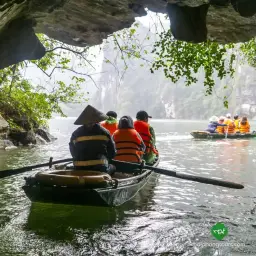
- Expect security checks, managed boarding and heavier congestion than on an ordinary Tràng An day.
- Confirm whether normal sightseeing boat routes operate unchanged during the festival.
- A standard boat ticket does not guarantee participation in a ceremonial procession.
- Use a life jacket as directed and keep phones, cameras and documents protected from water.
- Keep the full day flexible; a crowded boat site is difficult to combine with a fixed evening departure.
Best for: travelers specifically interested in a landscape-based spiritual event and willing to accept slower boat logistics. Visit Tràng An on a different day when scenery and a predictable sightseeing route are the priorities.
5. Christmas at Phát Diệm Cathedral
Christmas at Phát Diệm Cathedral is a religious celebration rather than a tourism festival, but it is one of the area’s largest recurring public gatherings. The stone-and-timber cathedral complex becomes a focus for the diocese, with decorations, the Nativity scene, music and the Christmas Eve vigil and Mass.
The central observance falls on the evening of December 24 and Christmas Day. Concerts, choir programs and parish activities may occur on other dates, so check the Diocese of Phát Diệm announcement if a specific performance matters to you.
Practical plan
- Choose between a daytime architecture visit and the much busier Christmas Eve worship period.
- During Mass, enter quietly, keep aisles clear and do not use flash photography.
- Visitors of any faith may attend respectfully, but seating and priority belong to worshippers.
- Arrange the return journey before evening; demand for local transport rises after services.
- Use the exact cathedral or diocesan notice for the liturgy time rather than a social-media repost.
Best for: travelers who understand that the religious service is the main event. A normal daytime visit is better for studying the architecture at a quiet pace.
Which festival should you choose?
- Largest spring pilgrimage atmosphere: Bái Đính.
- Strongest ancient-capital history: Hoa Lư.
- Most convenient from Tam Cốc: Thái Vi.
- Most distinctive landscape setting: Tràng An.
- Major Christian celebration: Phát Diệm at Christmas.
A festival is worthwhile when the ceremony and crowd are part of what you want to experience. If your main goal is architecture, photography or a calm boat ride, visiting outside the event date usually gives you more control over timing.
Transport and itinerary planning
Bái Đính, Hoa Lư, Thái Vi and Tràng An are in the same broad tourism region, but their festivals occur on different dates and at different venues. Phát Diệm is farther south and should be planned as a separate journey, especially for a late-night Christmas service.
Travelers coming from Hanoi on an ordinary sightseeing day can compare the current Ninh Binh day-tour itineraries from Hanoi. Current packages pair either Bái Đính or Hoa Lư with Tràng An or Tam Cốc and other stops. They are standard sightseeing programs, so ask specifically about festival traffic, changed access and whether the selected package operates normally on your date; they do not cover Thái Vi Festival or Phát Diệm Christmas.
- Book accommodation early for major opening days and the April–May holiday period.
- Keep your hotel name, driver number and meeting point written offline.
- Carry water, sun protection, rain protection and footwear suitable for long standing and walking.
- Keep valuables secure in dense crowds and use only clearly identified parking or transport services.
- Confirm the final return time before joining a procession, boat queue or evening service.
Pick one festival for its meaning and atmosphere, then let the official annual schedule determine the day. That approach avoids stale calendar claims and leaves enough time to experience the event respectfully rather than rushing through several crowded sites.