
For a late Noi Bai arrival, use a prebooked driver with written pickup and flight-delay terms for the most predictable same-night trip to Hai Phong. Domestic flights arrive at T1 and international flights at T2; an international passenger must clear immigration, collect bags and pass customs before meeting a driver. Route 86’s last listed T2 departure is 22:15, with T1 served afterward, so compare that cutoff with public-side-ready time, not scheduled landing. Hai Phong Tours’ airport-to-Hai-Phong service lists 120 km and about two hours. If no driver is confirmed, request a quoted intercity ride from the official airport taxi service or stay near the airport and travel after rest.
Choose by the time you reach the public hall
- Continue directly to Hai Phong: suitable when the vehicle, terminal, meeting point, delay response, luggage space and full drop-off pin are confirmed before the flight.
- Use an airport taxi as a backup: workable only after a driver accepts the intercity destination and gives the complete quoted fare.
- Stop for the night: the lower-risk plan when no driver is committed, the group is exhausted or a delay has removed the public-transport margin.
A scheduled landing time records when the flight is due to arrive, not when the traveler can enter a car or board a bus. Build the plan from the terminal exit. A checked bag, a remote gate, immigration or a baggage problem can move that exit far beyond the time shown on the ticket.
Allow for the real T1 or T2 arrival process
A domestic passenger arrives at T1 and enters the public area after collecting checked baggage and completing any required baggage inspection. A traveler with cabin baggage only may move faster, but the pickup plan should still identify the correct T1 arrival hall and a public-side meeting point.
An international passenger arrives at T2. The airport’s sequence places immigration before baggage claim, followed by customs before the public arrivals area. A driver cannot remove those steps, so send the flight number and ask the booking to monitor messages while the passenger remains inside.
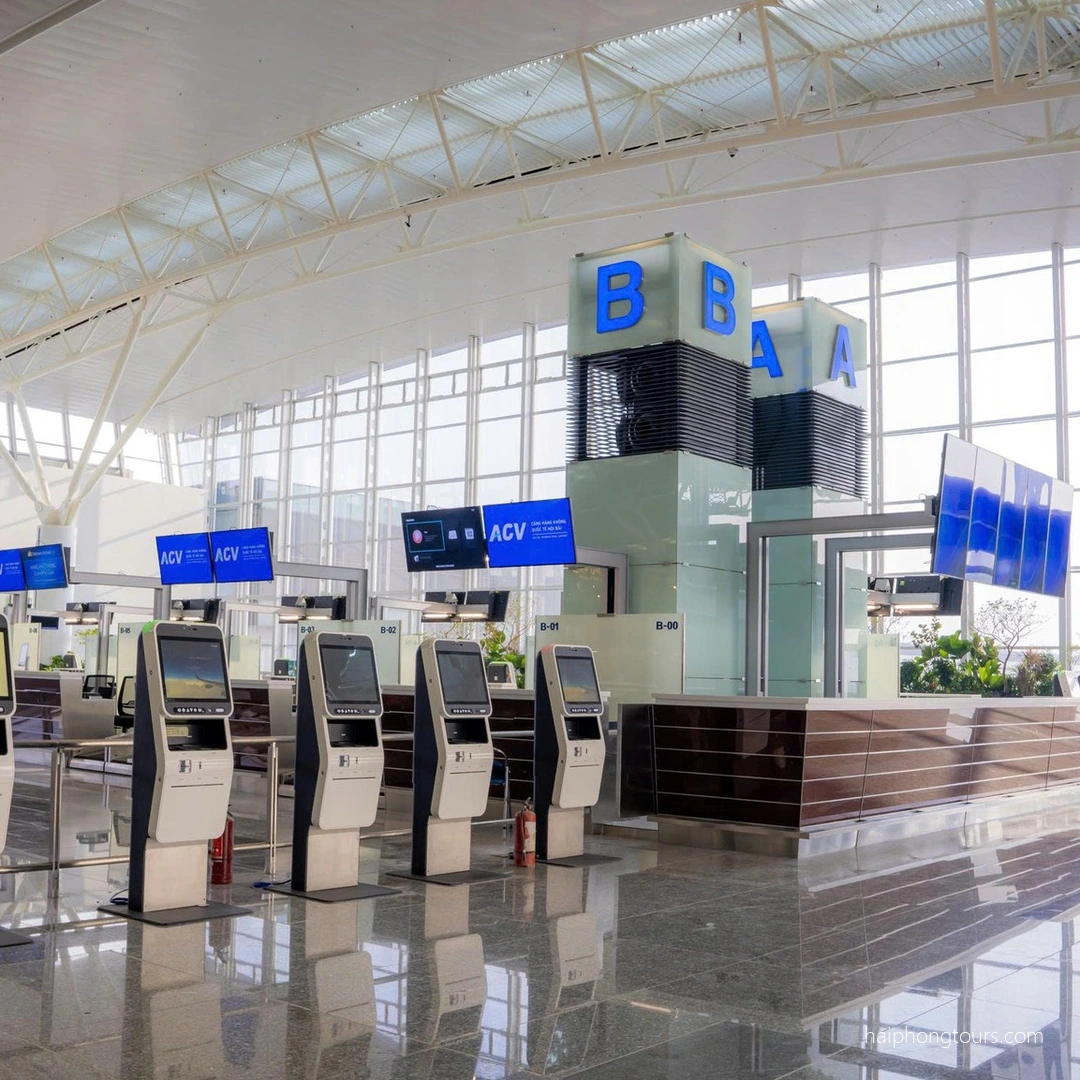
Confirm the terminal from the operating flight, then tell the driver whether the traveler has checked baggage or needs mobility assistance. A terminal change should trigger a new meeting instruction. The airport has a free shuttle between T1 and T2, but using it adds another wait and should be a recovery step rather than the original pickup plan.
Test the night with a realistic clock
Worked example: suppose an international flight is scheduled to land at T2 at 21:30 and the traveler has checked baggage. For this illustration, assume 60 to 90 minutes from touchdown to the public hall, then 15 minutes to find the agreed pickup point and load. This interval is an example, not a measured airport processing time or guarantee. It produces an illustrative road departure between 22:45 and 23:15.
Adding the direct service’s approximate two-hour road estimate gives an illustrative Hai Phong arrival between 00:45 and 01:15. Add more time if the flight is late, the destination is outside the central city, heavy rain affects the road or the group needs a slower transfer. The exact pickup and mapped destination control the useful estimate.
Route 86 cannot be the base plan in that example. Its final listed airport departure is 22:15, before the traveler is likely to reach the public side. Even an earlier landing does not make the connection safe unless immigration, bags, the walk to the stop and a missed-bus fallback all fit before the published departure.
Book the direct road transfer as one complete journey
A prebooked vehicle avoids the nighttime airport-to-Hanoi and Hanoi-to-Hai-Phong handoffs. The direction-specific transfer from Noi Bai Airport to Hai Phong lists pickup anywhere at HAN, drop-off anywhere in Hai Phong, 120 km and approximately two hours. It includes the driver, fuel, tolls, vehicle entrance fees and parking.

Before payment, get six details in writing: T1 or T2, the exact public-side meeting point, the flight number used for coordination, how long the driver waits after a delay, how to contact the driver after landing, and the complete Hai Phong drop-off pin. Also ask what happens if immigration or baggage delivery extends beyond the agreed pickup time.
Send a real luggage inventory rather than only the number of passengers. Count large and medium suitcases, cabin bags, a stroller, wheelchair, golf clubs and any boxed item. The service advises choosing the vehicle by people and luggage because filling every passenger seat can leave little or no bag space.

Keep the driver’s number, booking contact and Hai Phong address available offline. Airport Wi-Fi or a roaming connection can fail at the moment the traveler reaches the public hall. Choose one person to communicate for the group so the driver does not receive conflicting meeting instructions.
Use the airport taxi area as a conditional fallback
Noi Bai states that airport taxi passenger service operates from the first flight to the final flight of the day. That makes the signed airport taxi service a useful fallback after a late arrival, but it does not guarantee that every driver will accept an intercity Hai Phong journey.
Show the exact Hai Phong destination before boarding and ask for the complete quoted price, including tolls and any airport charge. Confirm the vehicle can carry every passenger and bag. If the destination, total price or payment method remains unclear, use the airport information desk and arrange an overnight stay rather than beginning an uncertain road trip.
Treat the 22:15 airport bus as a hard planning limit
Route 86 lists VND 50,000 and 26 airport departures, with the last leaving T2 at 22:15. In the airport-to-Hanoi direction it starts at T2 column 14, then serves the signed Bus 86 stop on the T1 arrivals level before continuing to Hanoi Railway Station. Do not treat 22:15 as the T1 pickup time because no separate T1 time is listed. Follow current signs at the terminal because a stop location can change.
The bus goes to Hanoi, not Hai Phong. It is useful only as one part of a longer chain, such as reaching a Hanoi hotel or a later dated train. The flight, bus and railway ticket are separate services, so a delayed arrival does not protect the next leg.
Search the official railway booking system at dsvn.vn for the actual travel date before choosing a hotel or station transfer. Hanoi, Long Bien and Gia Lam are different boarding points. Use the station printed on the issued ticket, and plan a separate road link if the airport bus does not serve that station directly.
Choose the right overnight stop
An airport-area hotel reduces the number of late-night steps and suits a tired traveler who wants to restart the journey after sleep. Confirm the hotel’s exact address, its late check-in procedure and the transport needed from the terminal. The words near the airport do not mean the property is walkable.
A central Hanoi hotel makes sense only when it fits the next confirmed departure. If the next train leaves from Hanoi Railway Station, choose the room after checking the dated ticket and calculate the morning trip to that station. Moving into Hanoi at night simply to leave again early can add time without improving the journey.
If there is no confirmed night vehicle and the group includes children, an older traveler, limited mobility or several heavy bags, the overnight plan usually removes more risk than it adds. It also gives time to solve delayed or missing baggage before starting a two-hour intercity road journey.
Late-arrival checklist
- Operating flight number and confirmed arrival terminal: T1 domestic or T2 international
- Checked bags, immigration, customs and mobility needs included in the exit-time estimate
- Written public-side meeting point and a working driver contact
- Written delay, waiting and no-show terms for a prebooked vehicle
- Exact Hai Phong drop-off pin and vehicle capacity for every person and bag
- Route 86 used only when the traveler can reach the signed stop before the listed 22:15 departure
- Airport taxi quote or overnight accommodation ready as the fallback
Continue to Hai Phong on arrival night when one confirmed vehicle can collect the group after the real arrival process and carry it to the final address. Use an airport taxi only after the intercity trip and complete price are agreed. When neither road option is secure, stop near the airport and rebuild the public-transport plan from a dated ticket after rest.