
At a railway crossing in Vietnam, stop before the stop line whenever crossing staff direct you, a red stop light shows, a warning sounds, or the barrier is moving or closed. A sign-only crossing with no guard, barrier, bell or light still requires a full stop: look and listen both ways, then cross only when no train is approaching and the road beyond can take the whole vehicle. Never open a closed barrier. If a vehicle or load blocks the track, get people clear and immediately warn crossing staff or railway personnel and any approaching train. Attempt to clear the obstruction only without endangering people; call 112 and report the exact location to the rail-safety hotline at 0369 118 118.
Stop for every controlled indication
A guard’s instruction, red stop light, red flag or sign, horn, bell, loudspeaker warning, or a barrier that is moving or closed means stop on your side of the crossing before the marked line. This applies even when other road users are moving around you or the train is not yet visible.
A train passing does not by itself cancel a stop indication. Wait until the barrier is open, the stop signals have ended and any crossing staff allow traffic to move. Never lift a closed barrier or drive around it.
Make a full stop at a sign-only crossing
A crossing without a guard, barrier, bell or light is not a slow-and-go junction. Stop before the line, listen for a train horn and observe both directions. Cross only when you can establish that no train is approaching.
If buildings, vegetation, darkness, rain or queued vehicles prevent a clear check in both directions, remain stopped. Use another legal crossing or seek authorized local or railway direction rather than guessing from the absence of a horn.

A navigation app can help identify the road, but it cannot show that the track is clear. Keep the phone with a passenger or wait until the vehicle is safely stopped away from the crossing before changing the route.
Keep the whole vehicle out of the crossing queue
Before moving, look beyond the rails. Enter only when the traffic ahead leaves enough room for the whole vehicle to pass both stop lines without pausing on the crossing. If the exit is blocked, remain before the first line even when no train is visible.
Do not turn around, stop or park between the two stop lines. If a vehicle ahead slows after the tracks, wait for a complete space rather than following it into a queue that can close behind you.
Treat a faulty control as a stop problem
At a staffed crossing where a light or barrier is faulty, crossing staff direct the road traffic. Follow their authorized direction. If there is no authorized direction, remain before the line and do not decide for yourself that the crossing has reopened.
A long wait, damaged barrier or light that appears inconsistent is not permission to touch the equipment or self-authorize a crossing. Report the problem to crossing staff, the nearest railway facility or the rail-safety hotline, and use a legal alternative crossing if directed.
Act immediately when the track is obstructed
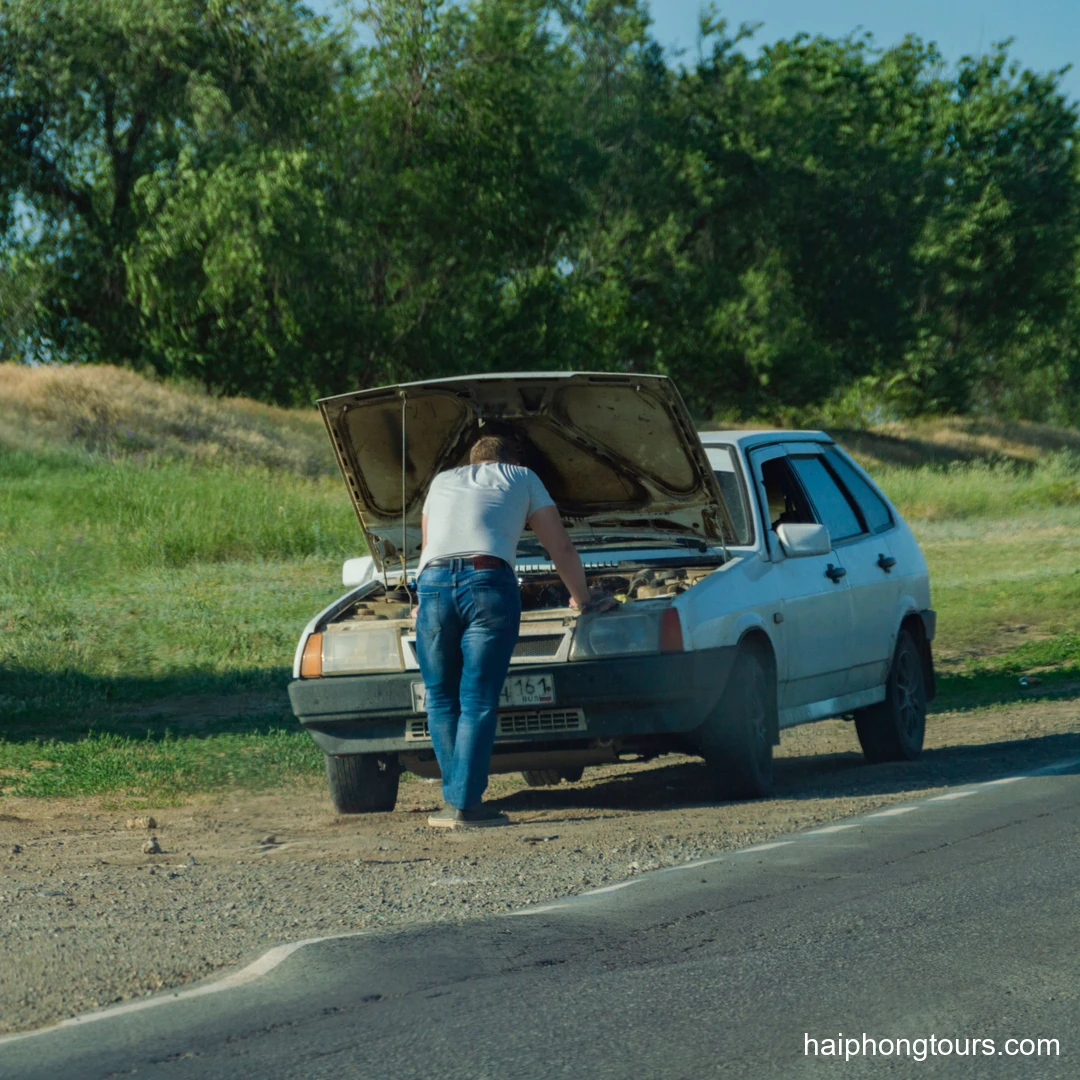
If a vehicle breaks down, crashes or drops cargo within the crossing and cannot move clear immediately, this is a railway emergency. The driver must rapidly get people clear and, only without endangering anyone, try to move the vehicle and cargo out of the crossing area. At the same time, anyone present must alert crossing staff or railway personnel and immediately warn an approaching train.
For an actual obstruction with a train approaching, direct a red flag or red cloth by day, or a red light at night, toward the approaching train from a position clear of the rails. This train-stop warning is only for an actual emergency, not an ordinary barrier wait. Do not walk along the track to estimate a distance or place an improvised object on the rails.
Call 112 for immediate danger, injury or urgent assistance. It operates nationwide around the clock and is free from fixed and mobile phones. Also report a rail hazard to Vietnam National Railway Group’s rail-safety hotline at 0369 118 118.
Give the crossing location or map pin, the road and nearest landmark, whether a vehicle or cargo remains on the track, whether anyone is injured and whether a train is visible or audible. A connected phone call does not prove that a train has stopped. Stay clear of the rails and follow railway or emergency instructions.
Give passengers a specific safety role
During an ordinary approach or wait, the driver should keep control of the vehicle and watch the crossing. A passenger can check that the far-side exit is open, identify the location, make emergency calls and tell responders whether the obstruction has cleared. Passengers should not leave the vehicle during an ordinary wait or enter the track to take photographs.
In a hired vehicle, do not pressure the driver to follow a motorcycle around a barrier or recover time at a sign-only crossing. Hai Phong Tours recommends treating a closed crossing as an untimed delay, then adjusting the road plan or onward connection after the vehicle is safely clear.

Protect a fixed departure with a lawful fallback
If the route crosses a surface railway line before a flight, train, ferry or tour check-in, leave time for an unpredictable closure. A route estimate cannot guarantee that a barrier will be open when the vehicle arrives.
Wait for the crossing to reopen or use another legal crossing when the driver can reroute safely. Never replace a staffed or signed crossing with an informal track crossing, and never ask the driver to enter before the far side is clear.