
Quan Lan has a history that deserves more than a quick photograph on the way to the beach. Start with the communal house, pagoda and nearby shrines in the village centre, then decide whether to add the separate Tran Khanh Du shrine about 1.5 kilometres away. That is a manageable heritage visit; it is not the same as touring every island archaeological location associated with the old Van Don port.

A village-based visitor can keep this outing short. If you are staying at Minh Chau or a resort elsewhere on the island, arrange the road transfer to the communal-house area and a return collection. “Quan Lan” on a booking can mean the island rather than a room within walking distance of the old centre.
Know which building you are visiting
| Name to recognise | Main identity | How it fits the visit |
|---|---|---|
| Đình Quan Lạn | Communal house connected with village founders, protective figures and local historical memory | Begin here in the central heritage cluster |
| Chùa Quan Lạn | Buddhist pagoda beside the communal-house area | A separate religious building, not another name for the đình |
| Nghè Bản Thổ | A small shrine to the local land deity, described between the đình and chùa | A small-scale stop within the central grouping |
| Miếu Đức Ông and related Pham-family shrines | Memorial worship associated with local commanders | Follow the actual marked shrine, not a map label that merges every building |
| Nghè Trần Khánh Dư | A separate shrine to the commander associated with the Van Don victory | An additional road leg of roughly 1.5 kilometres from the communal house |
The words đình, chùa, miếu and nghè matter because they describe different roles. Translating every one as “temple” can make the visit look like several duplicate map pins when it is actually a set of distinct institutions.
Begin with the timber communal house
The present communal house belongs to the late nineteenth-century phase of a building tradition that moved with the settlement from the old Cai Lang port area. Heritage descriptions draw attention to its timber structure, carved dragon details and wooden floor. Look at those features rather than expecting the building itself to date from the foundation of the trading port.
From the entrance, take time to see how the public front space leads toward the more sacred inner area. Do not walk onto an altar platform or past a barrier because another visitor has done so. If the keeper is present, ask which sections can be entered and whether footwear should be removed.
Decorative carvings are best appreciated without touching. A close photograph is not worth leaning a bag, umbrella or tripod against an old timber element. If the interior is closed, the exterior and the arrangement of the surrounding buildings can still support a worthwhile short visit.
Continue to the pagoda and nearby shrines
The pagoda is a Buddhist place of worship and also preserves local devotional traditions. The cultural authority describes worship of Lieu Hanh and a benefactor known as Cu Hau alongside Buddhist figures. Treat the building as an active religious space rather than an exhibition whose objects can be rearranged for a photograph.
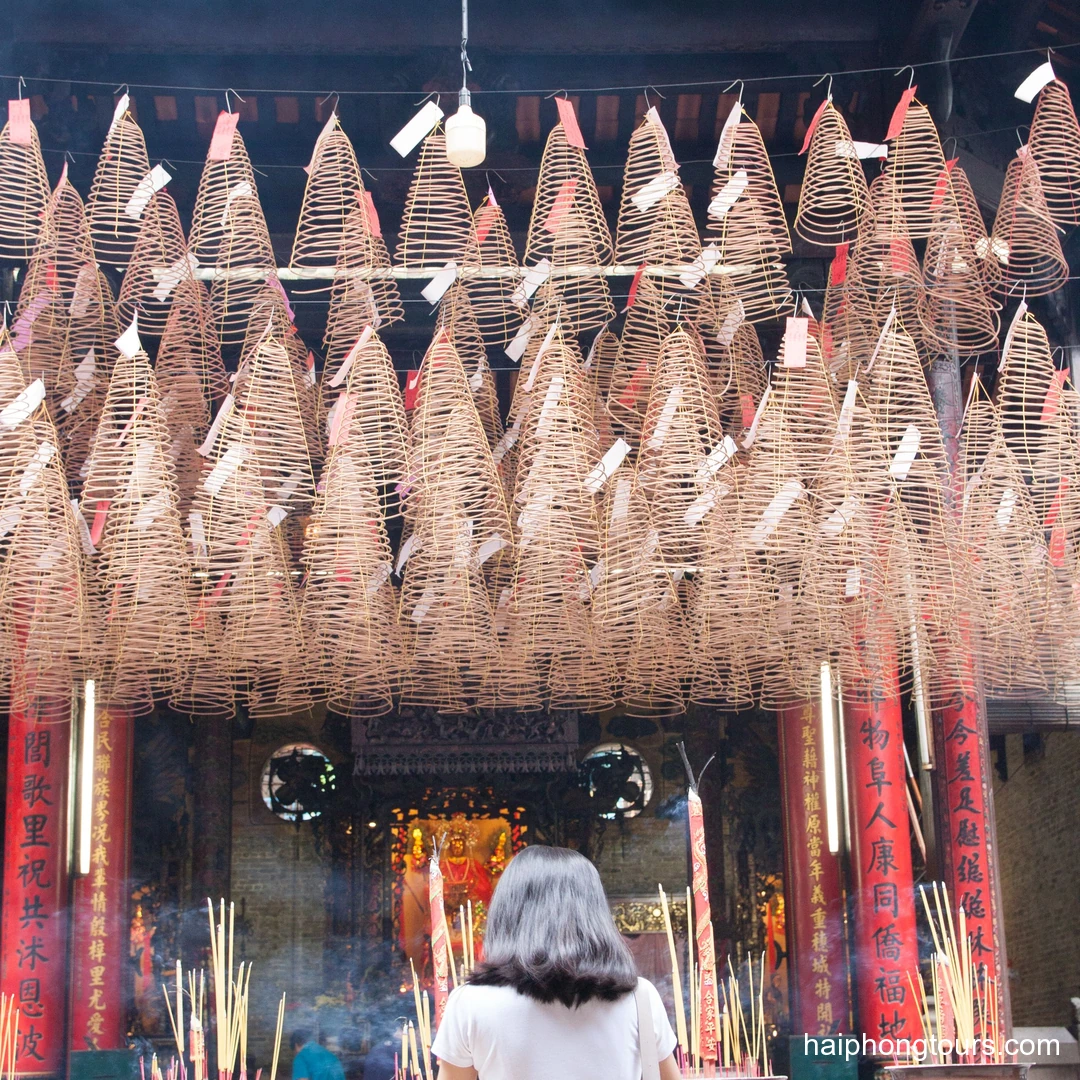
Walk between the buildings only through open, permitted approaches. Their proximity makes this a compact visit, but it does not establish that every doorway is open at the same time. A donation box is not a ticket machine; any contribution should go where the keeper directs, without expecting special access in return.
The Pham-family shrines relate to commanders remembered for the fighting against the Yuan-Mongol forces. If a guide uses a broad phrase such as “the three brothers’ temple”, ask which individual building you are looking at. This avoids mistaking one small shrine for the entire island’s memorial network.
Should you add the Tran Khanh Du shrine?
Nghè Trần Khánh Dư is outside the compact central grouping. Official heritage accounts place it around 1.5 kilometres from the communal house and record later rebuilding and restoration. A historic person, an old sacred location and a later building fabric can all be part of the same site.
Allow a separate outing rather than assuming it is the next courtyard. For walkers, the approximate distance means around three kilometres out and back before local wandering; use the actual current road route, not a straight line across fields. In strong sun, rain or with limited stamina, an arranged local vehicle is the more practical choice.
Give the driver the precise shrine name. A general request for “Tran Khanh Du temple” can be ambiguous when several commemorative places are discussed in local histories. Agree whether the vehicle waits and where you will meet again.
Understand the port story without searching for a reconstructed harbour
The official Van Don historical account identifies King Ly Anh Tong with establishing Van Don’s trading settlement in 1149. This history concerns a maritime trading system, not a single modern waterfront museum. Archaeological work around Cong Cai and Son Hao has produced evidence of that commercial past.
Do not expect all archaeological traces to form a signposted public walking attraction. Nor should you pick up pottery fragments or cross a working shoreline to look for evidence yourself. The village buildings provide a clearer visitor route; a specialist archaeological outing needs its own arrangement and permission.
A useful question for a guide is how the settlement’s relationship with the sea changed: trade, fishing, defensive memory and religious practice are connected, but they are not identical stories. This produces a richer visit than describing every structure simply as “a temple from the old port”.
The boat-racing festival is not a daily show
The traditional Van Don or Quan Lan communal-house festival takes place around the middle of the sixth lunar month, with the eighteenth day central to the celebration. Recent official event notices describe ceremonies across the communal house, Duc Ong shrine, Tran Khanh Du shrine and other named sites, together with racing between the Dong Nam Van and Doai Bac Vo teams.
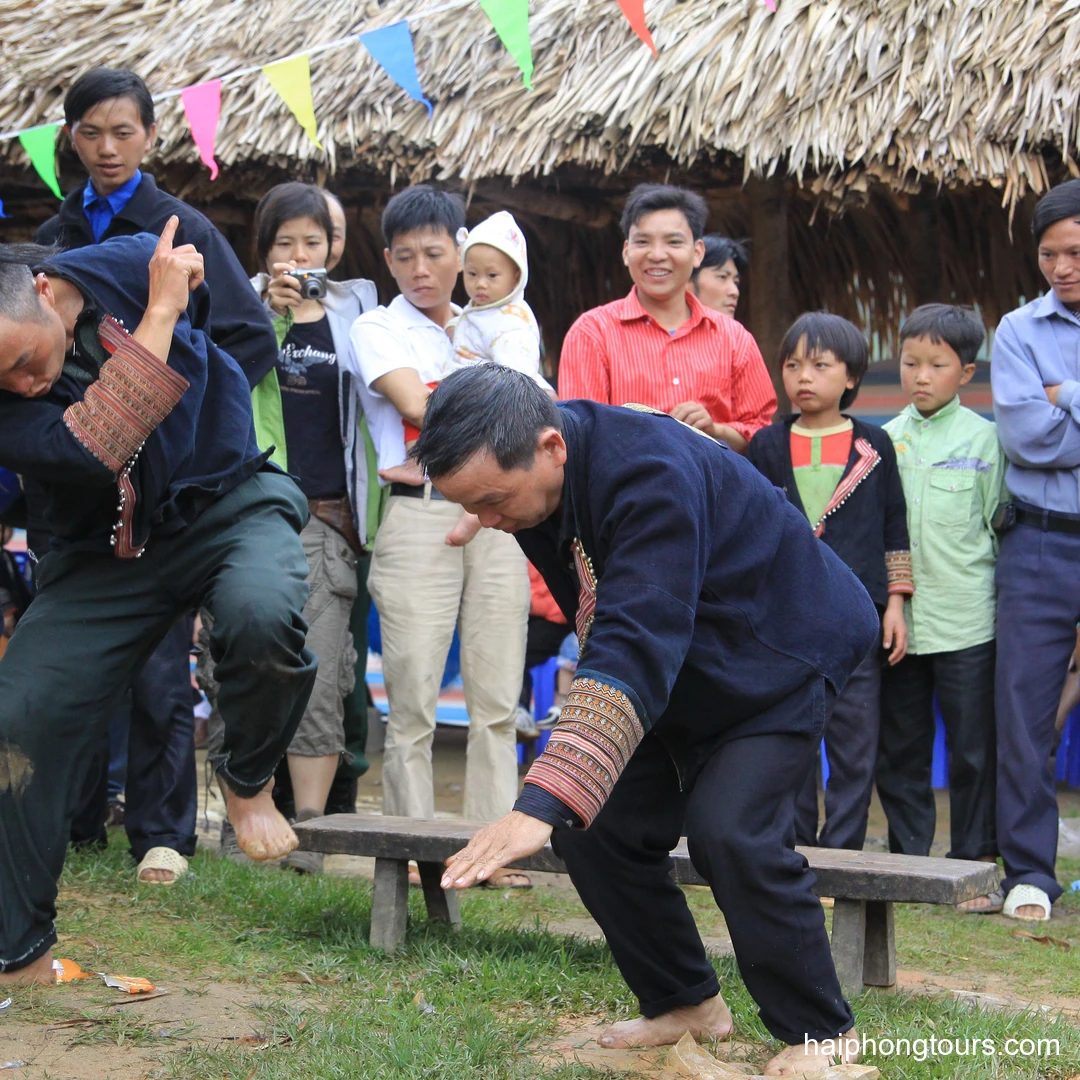
The exact programme follows the annual announcement. Do not convert a lunar date into a fixed Gregorian date or promise a race whenever a visitor arrives in summer. Outside the festival, the heritage walk is quieter in purpose and does not require an event to make sense.
Time, meals and access expectations
Plan roughly 60–90 minutes for the central buildings as a personal visit allowance, longer with interpretation or the outlying shrine. No dependable universal daily opening hours or admission tariff were established for every component. Ask your island host to arrange the keeper if interior access is important, and accept that worship or community use can take priority.
Dress for a religious visit, not directly for the beach: cover shoulders and knees and carry footwear that is easy to remove if requested. Take water and keep the visit out of the hottest part of the day where practical. The compact centre is not a guarantee of step-free entrances.
Have lunch in the village after the walk or return to your booked accommodation meal. For choosing a base, use the Quan Lan accommodation guide. Keep your boat departure protected with a separate transfer margin rather than adding the outlying shrine immediately before check-in.
Want a heritage stop within your Quan Lan stay? Contact us with your accommodation and boat times. We can help assess the sequence and local transport while site access is confirmed separately.