
Ho Chi Minh Museum is a separate, worthwhile stop in Hanoi’s Ba Dinh area if you want to understand how Vietnam presents the life and legacy of its revolutionary leader. Allow 90 minutes for a selective visit, or around two hours with detailed interpretation. Choose a Tuesday, Wednesday, Thursday, Saturday or Sunday and fit your visit into one opening session.
The museum combines documents, objects and large symbolic installations. A useful visit follows the biography while stopping to decode a few of those installations. It suits travelers interested in political history and commemorative art; our Hanoi museum comparison can help if your main interest is a different subject.

Opening sessions, tickets and the correct entrance
| Practical detail | Published arrangement |
|---|---|
| Address | 19 Ngọc Hà, Ba Đình, Hanoi |
| Open days | Tuesday, Wednesday, Thursday, Saturday and Sunday |
| Morning session | 08:00–12:00 |
| Afternoon session | 14:00–16:30 |
| Weekly closures | Monday and Friday, all day |
| International visitor ticket | VND 40,000 |
| Published free admission | Vietnamese visitors, visitors with disabilities and ICOM members |
| Suggested time inside | 90–120 minutes, depending on your interest |
The two-hour midday break matters: arriving at noon does not leave a usable lunch-hour visit. Aim for 08:30–10:00 or 14:00–15:30 if you want an unhurried introduction. Holiday notices can modify the regular timetable. The museum’s dedicated opening-hours page supersedes the older ticket page’s reference to daily morning sales.
Tickets are sold at the museum’s Door 1 and the 19 Ngọc Hà gate. Bring identification or membership evidence if claiming free admission. Ask about the applicable ticket for an international child rather than borrowing another attraction’s age policy. Carry small-denomination dong for a straightforward purchase.
For a taxi booking, enter “Bảo tàng Hồ Chí Minh, 19 Ngọc Hà, Hà Nội” so the driver sees the museum and city. Tell your driver where you will meet after the visit; a museum pickup and a mausoleum queue entrance are different destinations.
Arrange interpretation before you arrive
The Education Department handles requests for a museum guide and international groups. Call 024 3846 3757, or 024 3846 3752, extension 176. From abroad, replace the initial zero with +84. For general enquiries, the museum publishes 024 3845 5435 and truyenthong.bthcm@gmail.com.
Give your date, preferred session, group size and requested language. Agree on the meeting point, length and any guiding charge. An English website menu does not establish that an English-speaking guide will be immediately available. The public audio-guide page still describes a service under development, so arrange human interpretation if understanding the exhibits is central to your visit.
The website also displays an online-ticket control while saying the feature is being completed. Use the published phone contact or buy in person rather than relying on an unconfirmed online submission.
Understand the building and its approach to history
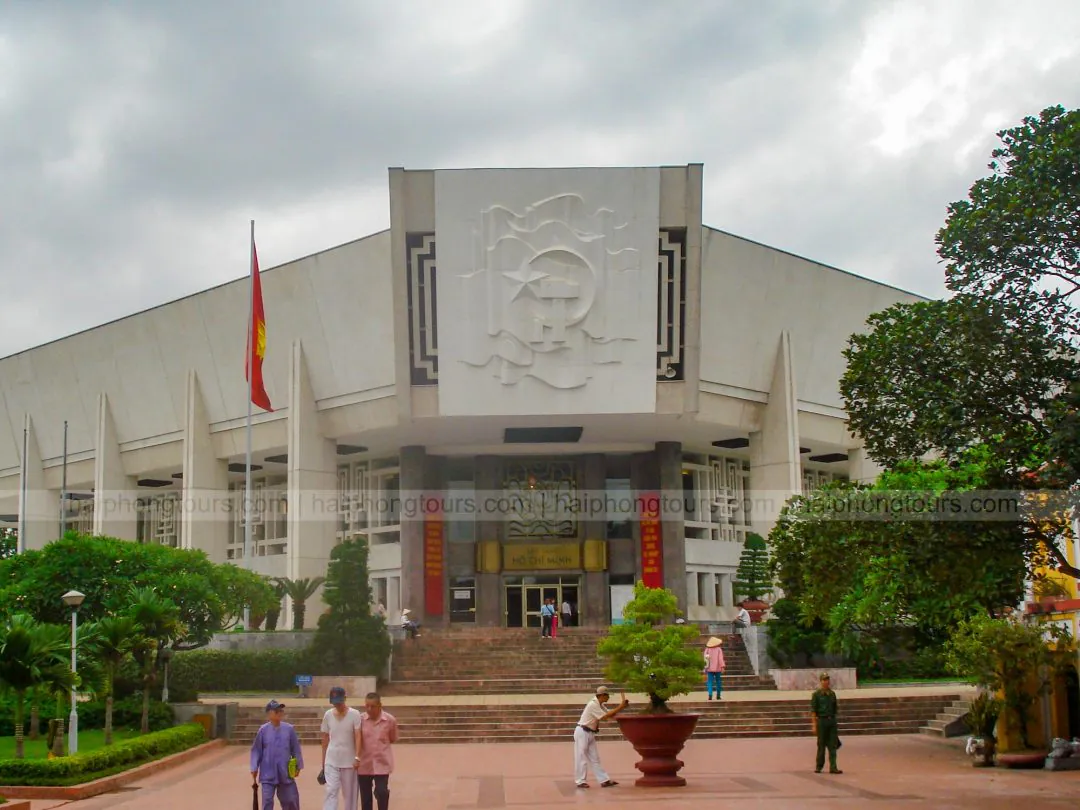
The museum opened on 19 May 1990, the centenary of Ho Chi Minh’s birth. Its architecture evokes a white lotus. Inside, the permanent exhibition connects three subjects: his biography, Vietnam’s revolutionary history and the international events that shaped that history.
The main biographical sequence provides your chronological route. Large artworks beside it summarize movements, places and periods; they often need interpretation rather than a quick photograph. Use the dated documents to anchor what you see in those compositions.
This is a commemorative institution with an explicit perspective on Ho Chi Minh and the Vietnamese revolution. Notice the difference between a contemporary document, an identified object, a reconstruction and a later symbolic artwork. Reading those categories separately makes the visit more informative, whether or not you share the museum’s political interpretation.
Three displays worth slowing down for
The family setting
The installation evokes Làng Sen in Kim Liên and the household associated with Ho Chi Minh’s childhood. Look for the loom associated with his mother, Hoàng Thị Loan, and the writing materials, books and medicine-preparation tools associated with his father, Nguyễn Sinh Sắc.
These details give you a manageable starting point: work, education and family life. Choose one object and read its label closely. The setting is an interpretive reconstruction, so do not assume every item is an original possession merely because it appears within a domestic scene. For children, comparing a loom with something used at home can be more engaging than memorizing names.
Pác Bó and the years 1940–1945
The Pác Bó display refers to the revolutionary base associated with Ho Chi Minh’s return to Vietnam. Its documents and relief cover the broader period 1940–1945, including the formation of the Việt Minh in May 1941 and the December 1944 directive establishing the Vietnam Propaganda Liberation Army.
First look at the relief as a complete composition, then choose one dated document to examine. This helps separate events compressed into the artwork from their actual sequence. The display represents Pác Bó within a Hanoi museum; it is not a surviving room from the original revolutionary base.
The five-petalled wartime installation
The installation titled “Vietnam fighting, 1946–1954” addresses the war against French colonial rule and the victory at Điện Biên Phủ. Its design uses a five-petalled flower, with each petal representing a factor that the museum identifies as contributing to victory.
Ask your guide to explain how the individual elements support that argument. The comparison with the family display is revealing: one reconstructs a household, while the other expresses a national historical narrative through an abstract shape. Allow time for both kinds of display rather than treating the larger artwork as decoration.
A practical 90-minute visit
This is a suggested pacing plan, not a museum-run tour or a promise that every gallery will be available.
- First 10 minutes: buy your ticket, follow the bag-deposit instructions and locate the start of the main exhibition. Meet your guide here if arranged.
- Next 25 minutes: follow the early biography and examine the family setting. Identify one object and its relationship to the accompanying text.
- Next 30 minutes: continue through the Pác Bó and wartime sections. Keep the dates in view as the display changes from documents to symbolic installations.
- Final 25 minutes: continue through the later biography, revisit a display that interested you and leave time to retrieve belongings.
For a longer morning, begin at the museum at 08:30 and finish around 10:00. Then consider One Pillar Pagoda and the surrounding Ba Dinh area, subject to their own access arrangements. If entering the mausoleum chamber is your priority, plan that separately first and use the museum’s afternoon session. The Ho Chi Minh complex guide explains the separate components; one ticket or timetable does not cover them all.
Bags, photography and visiting with children
The museum asks visitors to dress properly, remove hats, leave luggage and bags in the designated place, avoid eating and smoking, and keep hands off exhibits. Children under ten must be accompanied by adults or an excursion organizer. Keep voices low while other groups listen to explanations.
Ask reception before photography or filming; the published rules direct these enquiries to staff. If you require a step-free route, a lift or seating breaks, describe those needs when contacting the museum so you can agree on a workable entrance and gallery route.
Include the museum in a guided Hanoi day
Hai Phong Tours’ private Hanoi city tour lists Ho Chi Minh Museum within its morning complex visit and includes private transport, an English-speaking guide and entrance tickets. Tell us if you want the museum to be a main stop: time spent inside needs to be balanced with the day’s other attractions.
Want time to understand the exhibits? Contact us with your date, hotel, group size, preferred language and any walking limits. We can plan the city route around an operating museum session and your interests.