
A late trip to Cat Ba should continue to the island only when four links are confirmed for the actual arrival time: the mainland vehicle, an operating crossing, the island vehicle and hotel reception. If any link is uncertain, stop at a confirmed mainland hotel and restart in daylight. Chasing a possible last crossing is not a safe booking strategy.
Build the decision from your road-ready time, not the scheduled landing, train arrival or bus time. Road-ready means that every traveler has exited, collected luggage, used any essential facilities, found the driver and loaded the vehicle. A small inbound delay can remove the margin between arriving at the terminal and actually boarding.
The four-link test for a same-night island arrival
Continue to Cat Ba only when you can answer yes to all four questions:
- Can the mainland driver reach the correct crossing before its confirmed cutoff?
- Is that ferry or cable-car service operating on your date and in the current weather?
- Will a named island driver meet the actual arrival, with room for the declared bags?
- Has the hotel accepted the revised check-in time and provided a working late contact?
A general timetable or an online map estimate is not enough. Crossing schedules can change by season, day and official weather instruction. Use the current operator or government notice for the travel date, then reconfirm if the inbound service is delayed.
Ferry and cable car solve different parts of the trip
The Dong Bai–Cai Vieng ferry and the Cat Ba cable car are not interchangeable late-night guarantees. Each has its own operating window, boarding process and baggage conditions. The cable car may have a scheduled closed day or a luggage rule that makes it unsuitable for your group; the ferry can face queues or suspension.
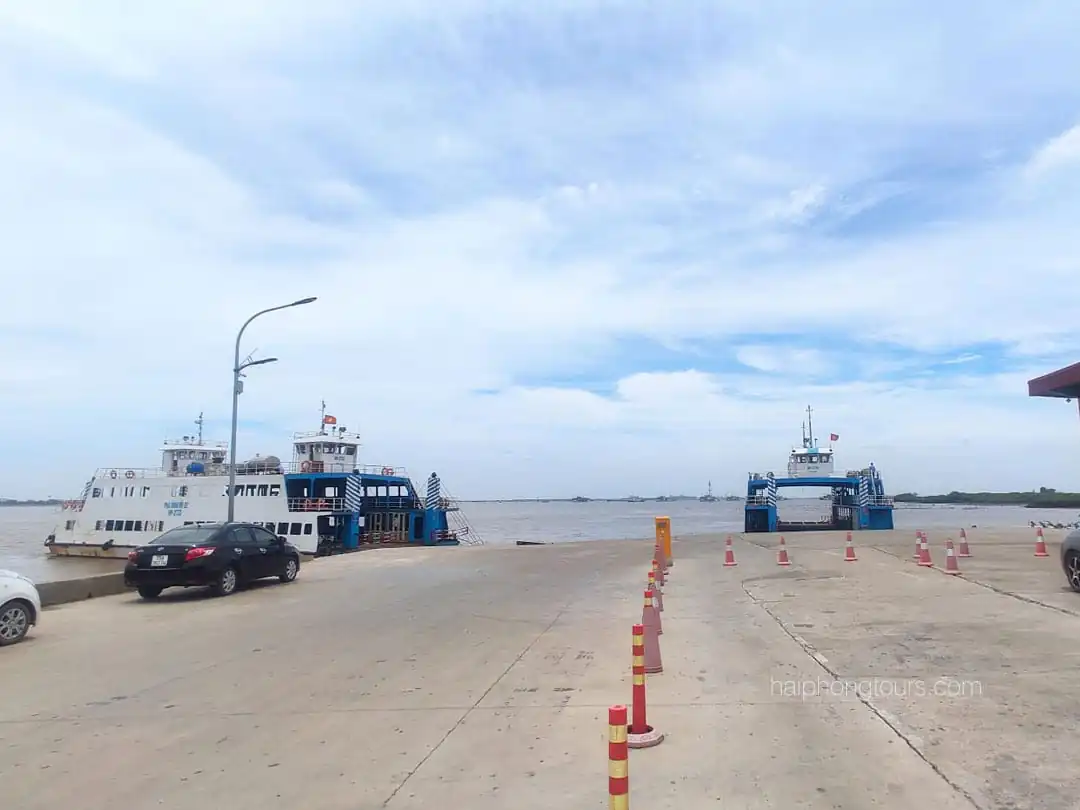
Neither crossing delivers you to every Cat Ba hotel. You still need the island last mile from the arrival point to Cat Ba Town, a resort or a rural property. Confirm the exact island meeting pin, driver’s name and phone number before the mainland driver leaves.

Weather can cancel the whole chain
Official storm or safety instructions can suspend a crossing even when an older schedule shows a departure. Do not ask an unofficial boat or vehicle to bypass a closure. If the responsible authority or operator has not confirmed service, treat the island as unavailable for that night.
Heavy rain, wind and low visibility also slow road access and baggage movement. A plan that works only when every stage runs at its fastest is already too fragile for a late arrival.
When the mainland overnight is the better choice
Use a mainland hotel when the crossing is closed, the final departure cannot be verified, the island driver has not confirmed, the Cat Ba hotel no longer accepts the ETA, or one ordinary delay would leave you stranded at the terminal.
Choose a property that is reachable by the current vehicle, has confirmed late reception and can arrange or accept the next morning’s pickup. “Near Cat Ba” is not specific enough; obtain the exact entrance pin and check whether the driver can stop there with your luggage.
Do not release the driver at an unconfirmed hotel
Before unloading, call or message the property. Confirm the reservation name, room availability, payment method and who will open the door. If reception is closed and no staff member answers, stay with the vehicle while arranging a different staffed property.
Ask about bottled water and a simple meal before arrival. Late roadside searches are especially poor choices for families, solo travelers, older travelers and anyone carrying large bags.
Protect luggage at every handoff
Count and measure the bags before travel. Identify who carries each item from the mainland vehicle to ticketing, through the crossing and into the island vehicle. Do not assume a porter is included. Keep passports, medicine, cash, electronics and one dry layer with the traveler.
If the group uses two vehicles, send the same baggage list to both drivers. Photograph the bags before a handoff and agree on a meeting point that is more precise than the terminal name.
Send one decision message before leaving the arrival point
A useful message to the transport and hotel contacts is: “We expect to be road-ready at [time], with [number] passengers and [number] bags. Please confirm the exact crossing, its current operation, the island meeting pin, the receiving driver’s details and that the hotel accepts our revised arrival.”

Do not depart until the answers form one complete chain. Hai Phong Tours recommends recording the confirmations in writing because separate transport, crossing and hotel bookings do not protect one another.
How to restart the next morning
Recheck the day’s crossing before leaving the mainland hotel. Confirm the pickup time, terminal, passenger and baggage rules, island vehicle and hotel arrival. Build a queue and loading buffer rather than planning to reach the terminal at the scheduled departure time.
If weather remains uncertain, keep the mainland room until the operator confirms service or arrange a flexible extension. Do not move to an exposed or unstaffed terminal simply to wait closer to the crossing.
The practical decision
Continue to Cat Ba late only when every link from the current vehicle to the hotel door is confirmed. Otherwise, a staffed mainland overnight is the correct travel plan, not a failure. It preserves your luggage, rest and ability to make a controlled island crossing the next day.
Useful guides for your trip
Would you like help fitting this experience into your trip? Contact us with your travel dates, starting point, available time and group size. Tell us about walking limits or special interests so we can suggest a practical itinerary.