
Cat Ba can work for some travelers with limited mobility, but it should not be treated as a uniformly wheelchair-accessible island. The most dependable plan is to verify the complete route from your arrival vehicle to your hotel room, keep transfers to a minimum, and choose each outing by its actual steps, surface, toilet access, and assistance rather than by distance alone.
If you cannot manage any steps, cannot transfer out of your wheelchair, or need a vehicle lift or wheelchair securement, obtain written answers before paying. Until every segment is confirmed for your exact trip, do not assume a continuous step-free route through the ferry or cable-car stations, Cat Ba Town, the main beaches, either major land cave, or the National Park’s short walking routes.
Start with your non-negotiable access needs
Accessibility is a chain. A ramp at one entrance does not solve an unsuitable vehicle, a stepped bathroom, an unmanageable cave, or an emergency route that uses stairs.
Write down your stop conditions before comparing hotels or activities:
- whether you remain in your wheelchair or can transfer into a standard vehicle seat;
- the unfolded and folded dimensions, total weight, and battery type of your wheelchair or mobility scooter;
- the maximum number of steps you can manage, whether you need a handrail, and whether slopes are acceptable;
- how far you can walk before sitting and how often you need a rest;
- whether you need a roll-in shower, shower seat, grab rails, side-transfer space, or a specific bed height;
- whether assistance from a trained person is required and what staff may safely help with;
- whether an accessible toilet must be available during every transfer and outing.
Send the same information to the transport provider, hotel, and attraction. A general label such as senior-friendly, easy, or accessible is not a substitute for an answer about your exact route.
Choose the arrival route by its handoffs
Most land-based arrivals include a ferry or another water crossing, or the Cat Hai–Phu Long cable car; many routes still require a final road transfer. The best option is the one with the fewest unverified handoffs for your needs, not necessarily the option with the shortest advertised journey.
Dong Bai–Cai Vieng vehicle ferry
The current vehicle ferry connects Dong Bai on Cat Hai Island with Cai Vieng on Cat Ba Island. A suitable vehicle crossing with you may reduce the need to move between seats, but this is only useful when the operator confirms that the vehicle can board on your date and explains what passengers must do at the terminal and during the crossing.
Ask whether you must leave the vehicle, how you reach the waiting area and ferry deck, whether ramps change slope with the tide, where your wheelchair is secured, and whether an accessible toilet is available. Officials sometimes restrict car loading during peak traffic periods, and ferry service can be suspended for severe weather, so keep a delay or overnight backup.
Cat Hai–Phu Long cable car
The cable car crosses to Phu Long near Cai Vieng; it does not take you directly to Cat Ba Town. Your access chain still includes arrival at Cat Hai station, ticket gates and boarding, the cabin threshold, exit at Phu Long, mobility-device and luggage handling, and another vehicle to your hotel.
Before choosing this route, ask for the clear width of gates and cabin doors, the height of thresholds, whether the cabin can be slowed or stopped for boarding, lift coverage inside both stations, the nearest accessible toilet, and the exact staff assistance available. Confirm that your onward vehicle is waiting at Phu Long and can carry your device.
Bus, shuttle, taxi, or private vehicle
Confirm the actual vehicle, not just the service category. Ask for the seat height, door opening, internal steps, ramp or lift, wheelchair securement, luggage space, and whether staff will handle a powered chair or scooter. If you cannot transfer, state clearly that you need to remain seated in your device.
Cat Ba’s central traffic plan restricts parking by vehicles with 16 or more seats on several streets. A large bus may therefore use a transfer point instead of stopping at the hotel entrance. Obtain the final drop-off location, distance, surface, slope, and any change of vehicle in writing.
Four-wheel passenger shuttles operate only on authorized routes and within authorized times. They should not be treated as a guaranteed late-night or door-to-door accessible service. Prearrange the return rather than relying on finding a suitable vehicle after an evening meal or attraction visit.
Plan Cat Ba Town one route at a time
A short map distance does not tell you about curbs, broken or obstructed paving, road crossings, gradients, parked motorcycles, crowding, or shelter from heat and rain. Ask your hotel for a current, continuous video from the intended vehicle stop to the entrance, reception, lift, room, breakfast area, and nearest usable public space.
For every town route, check:
- the exact curb or step at the start and finish;
- the steepest slope and the surface in wet weather;
- the narrowest clear width after signs, tables, parked vehicles, and street furniture;
- safe road-crossing points and nighttime lighting;
- seating and shade at intervals that match your stamina;
- a nearby toilet you can actually enter and use;
- where a suitable vehicle can collect you if you need to stop early.
Base yourself near the places you expect to use most, but verify the block and building rather than choosing from a neighborhood name. A hotel close to the waterfront can still have entrance steps, a steep approach, a lift that misses one floor, or a bathroom that cannot accommodate a wheelchair.
Verify the hotel room, not just the building
Ask the hotel to confirm your assigned room number or category and send current measurements or a video. Useful questions include:
- Can the confirmed vehicle stop at the entrance under current traffic rules?
- Are there any curbs, steps, steep ramps, drainage channels, or thresholds before reception?
- What are the clear widths of the entrance, lift, room door, and bathroom door?
- Which floors does the lift serve, and are there steps between the lift and the room?
- Is there enough turning and transfer space beside the bed and toilet?
- What are the bed and toilet heights, and where are the bathroom support rails?
- Is the shower level-entry, and can a stable shower seat be provided?
- Can the breakfast room and an accessible toilet be reached without steps?
- What is the evacuation plan if a lift cannot be used?
A spacious room is not automatically an accessible room. Photos taken from a wide angle can also hide thresholds and tight transfer space, so measurements matter.
Beach access means more than reaching the beach road
Cat Co Beach is in the town area, and a road connects Cat Co 1 and Cat Co 3. That location does not prove step-free access to the promenade, sand, water, toilet, or shower. Apply the same check to Tung Thu or any resort beach.
Ask where the vehicle can stop and request the route from that point to a shaded seat or viewpoint. Confirm every step and slope, the surface and clear width of any ramp or boardwalk, whether the route ends before the sand, and whether a beach wheelchair is available for your date. Do not assume staff can carry a person or an occupied chair.
If sand or water access is not confirmed, a verified waterfront viewpoint or paved section may be a better plan than a swimming visit. Check crowding, heat, shade, and the pickup point before setting out.
Cat Ba’s land caves are not dependable step-free stops
Trung Trang Cave
Trung Trang is a cave passage of roughly 300 meters through the mountain, and the National Park includes it among short walking or hiking options. “Short” does not mean flat, wide, well lit, or step-free.
If you have a step limit, ask for the current approach, entrance, complete interior route, narrowest and lowest sections, handrails, lighting, wet surfaces, exit, and turnaround option. A wheelchair user who cannot manage steps should not plan the full cave unless local management confirms a suitable continuous route for the exact device.

Hospital Cave or Quan Y Cave
Hospital Cave has a wooden staircase leading to its entrance and a three-level interior. Those are material barriers. Do not assume that being beside the cross-island road makes the visitor route accessible.
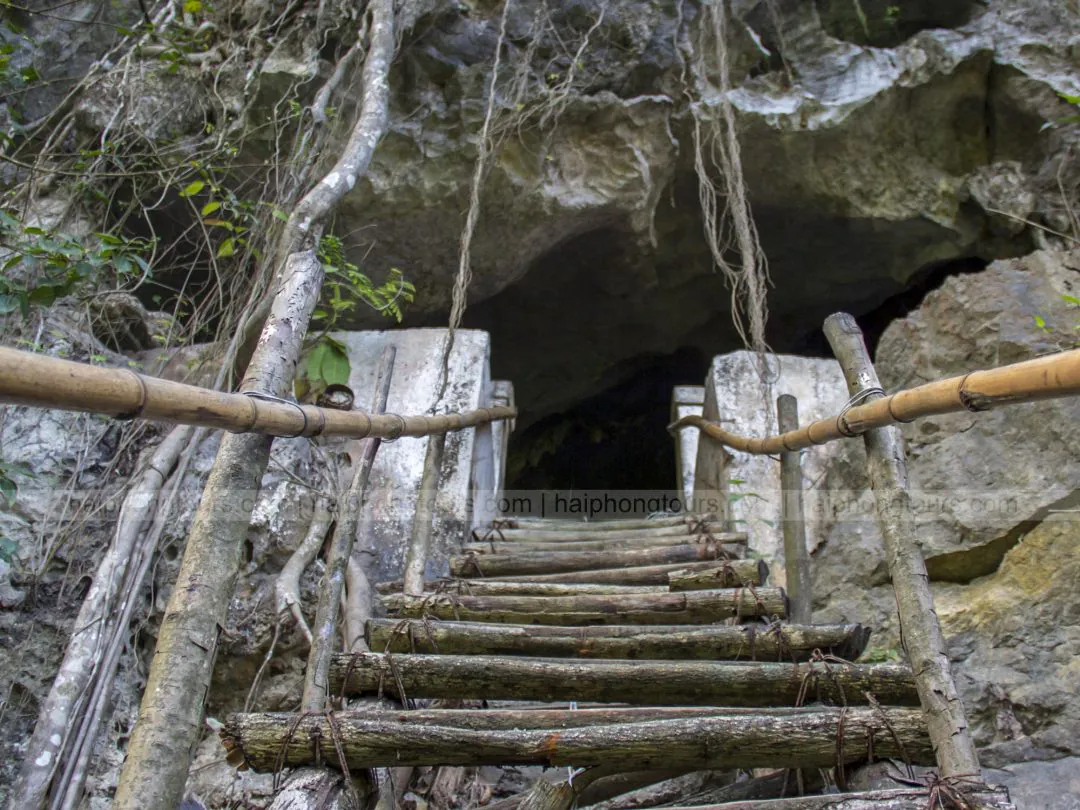
If you can manage some steps, confirm how many are unavoidable on the route open that day, their height and handrails, the amount of standing and walking, the lighting, and whether you return by the same staircase. If those details are not available, choose a town-based alternative rather than testing your limit at the entrance.
A short National Park route can still be a hike
Cat Ba National Park groups Kim Giao–Ngu Lam, the Environmental Education Route, and Trung Trang Cave among one-to-two-hour walking or hiking options. The park’s interior is rugged limestone terrain, so the published duration should not be used as an accessibility rating.
Ngu Lam is a hike and should be excluded from a step-free plan. The Environmental Education Route may be worth asking about when you can walk a limited distance, but its one-to-two-hour label gives no assurance about the current surface or gradients. Before traveling to the park, ask about:
- the exact start and finish and whether a vehicle can reach both;
- steps, roots, loose stone, mud, slopes, bridges, and narrow sections;
- handrails, rest seats, shade, and the distance between rest points;
- accessible toilets and drinking water at the entrance or trailhead;
- whether the route can be shortened or reversed safely;
- weather closures and current ground conditions.
If staff cannot describe the route precisely, treat it as an active walk. A slow pace and extra time do not remove a step, a narrow passage, or an unsafe surface.
Toilets, pacing, and backup transport
Do not assume that a terminal, cave entrance, beach, or trailhead has an accessible toilet. Confirm the entrance step, door width, turning space, support rails, toilet height, water supply, and whether the floor remains usable when wet. Identify the next verified toilet before leaving your hotel.
Schedule one main outing per half day and leave room for waiting, vehicle changes, heat, rain, and recovery. Keep medication, water, a phone, charging equipment, and essential mobility-device tools with the traveler rather than in luggage that may be separated during a transfer.
Arrange a return vehicle and save the pickup point in advance. If weather stops the ferry or cable car, or if an attraction route is worse than described, the backup should be rest or a verified town activity—not a rushed attempt to complete the original plan.
Build an emergency plan before arrival
Tell the hotel and transport provider what assistance you would need during a fire, power outage, medical event, or route interruption. Ask for a room and evacuation procedure that do not depend on using a lift. Do not make carrying an occupied wheelchair the default plan.
Keep travel-insurance details, emergency contacts, prescriptions, and the make and model of mobility equipment available offline. A travel companion should know how the device brakes, freewheel setting, batteries, and charger work without attempting repairs beyond their competence.
Accessibility questions to send before paying
- What is the exact vehicle and every transfer from my origin to the hotel entrance?
- Can I remain in my wheelchair, or must I transfer? If I must transfer, what seat and assistance are provided?
- What are the narrowest door or gate, highest threshold, steepest ramp, and total unavoidable steps?
- Where will my wheelchair or scooter be stored and secured? Are its weight, dimensions, and battery accepted?
- Can you send a current continuous video of the route, including the vehicle, entrance, lift, room, bathroom, and toilet?
- Where is the exact final drop-off, and can the operating vehicle reach it under current traffic rules?
- Which parts of the attraction can I skip, and where will I wait with an accessible toilet?
- What changes in rain, high wind, ferry restrictions, maintenance, or an emergency?
- Who has approved these arrangements, and will the same information be attached to my booking?
Ask for answers tied to your travel date, assigned room, operating vehicle, and actual attraction route. If a critical answer remains vague, remove that segment from the itinerary. Cat Ba is a better trip when the plan protects your independence and comfort instead of relying on last-minute lifting or improvisation.