
Dong Xuan makes more sense when you arrive with the right expectation: this is a working wholesale market, not a polished souvenir department store. The covered market, its surrounding food lane and the weekend Old Quarter night market are three related but different experiences.
Visit Dong Xuan in daylight for everyday trade and shopping, use the lane off Cau Dong for a focused food stop, and return on a weekend evening only if you also want the outdoor night-market corridor. You can enjoy the area without buying in bulk, but a stallholder’s minimum order and the price of a single item are not necessarily the same as the wholesale terms on display.
Find the correct side of the market
The market’s main frontage faces Dong Xuan Street. Hang Khoai runs along the northern side, Cau Dong along the southern side, and Ngo Cho Dong Xuan is on the eastern side. These four names are more useful for orientation than asking a driver to stop somewhere in “the Old Quarter.”
For a first visit, approach the main Dong Xuan Street frontage and establish a meeting point before entering. If your group separates, agree to meet outside a particular entrance rather than inside an aisle of similar-looking stalls. Take a photograph of the entrance or nearby street sign for your own reference.
The market is within the northern part of the Old Quarter walking area. From Hoan Kiem, the Hang Dao, Hang Ngang and Hang Duong corridor leads toward it, but this is a busy urban walk rather than a consistently pedestrianized route. Use crossings and leave room for deliveries around the building.
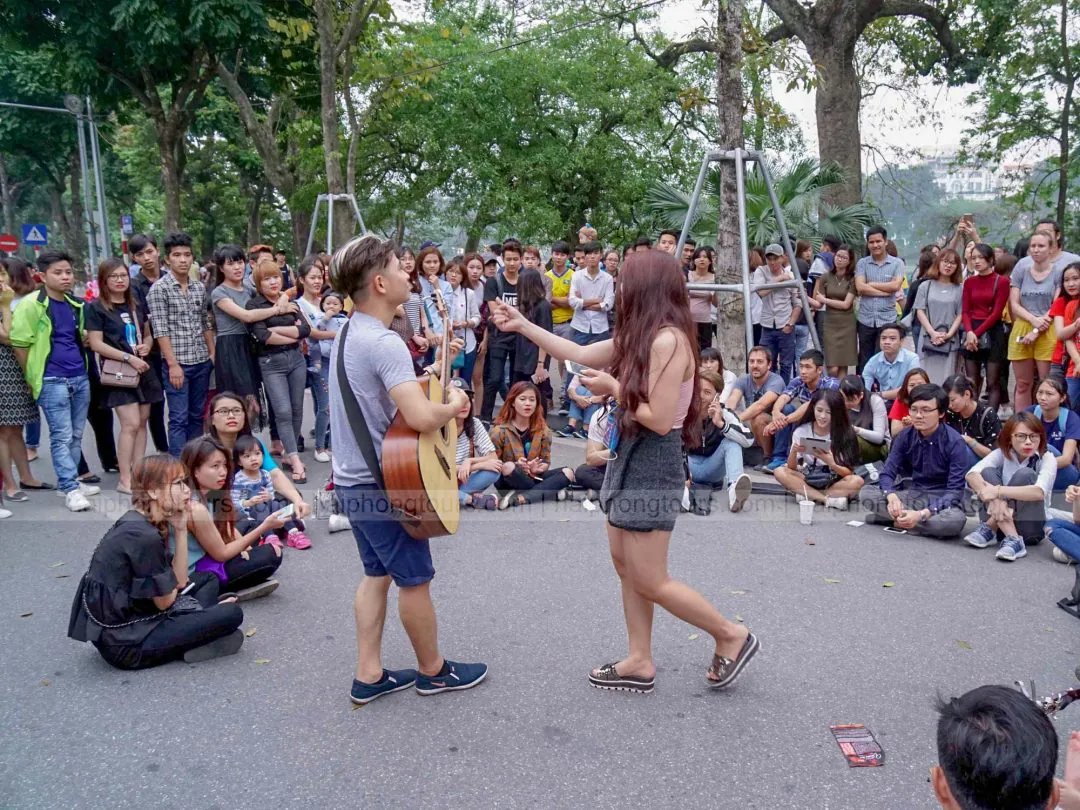
Day market, food lane or night market?
| Experience | What it is best for | Planning difference |
|---|---|---|
| Covered Dong Xuan Market | Seeing wholesale trade and comparing everyday goods | Go in daylight; individual stalls set their own selling arrangements |
| Ngo Cho Dong Xuan food lane | A bowl of noodles, a snack or a sweet dish | Approach from Cau Dong and expect compact seating |
| Weekend Old Quarter night market | An evening walk among outdoor stalls | The tourism directory lists Friday–Sunday, 6–10:30 p.m.; this does not mean the covered market stays open all evening |
Ordinary entry to the market area is free. Buying something, eating, or paying for vehicle parking is separate. Temporary traffic restrictions, weather and public events can change the evening experience; a weekend label does not guarantee every stall will be operating.
What is worth shopping for?
Clothing, accessories, fabrics, household items and small inexpensive gifts suit the market’s trading character. Look for something you can inspect and understand rather than assuming every product is locally handmade. A Vietnamese setting does not establish where an item was manufactured, what fiber it contains or whether a branded label is genuine.
For one or two souvenirs, start by asking whether the stall sells individual pieces. If it does, compare the single-item price rather than the cost advertised for a bundle. For clothing, check the actual measurements and seams; a familiar size letter can represent a different cut. For fabric, establish whether the quote is per meter, per piece or for a whole roll.
A low-price item is only useful if you can take it home. Consider fragility, weight and the rules at your final destination before buying food, plants, animal products or anything made from an unidentified natural material. For valuable jewelry, antiques or expensive branded goods, a hurried market transaction is not a substitute for documented provenance and a proper receipt.
A simple buying sequence that avoids confusion
- Choose the exact product. Point to the color, size and finish you want, not just a display sample.
- Establish quantity. Ask whether the price applies to one item, a set or a minimum wholesale order.
- Settle the total in Vietnamese dong. A calculator or written total is useful when spoken numbers are unclear.
- Inspect before paying. Open the package with permission, test a clasp or zipper and look for obvious damage.
- Agree on any exchange arrangement before leaving. Do not assume an international-style return policy.
Bargaining is a conversation, not a required percentage discount. Compare a few equivalent items, decide what the product is worth to you, and negotiate politely if the seller is willing. If the price is unsuitable, thank them and leave. Prolonging a negotiation after agreeing to buy rarely improves the experience.
Carry manageable denominations of cash and keep most of your money secure. A Vietnamese bank-transfer QR code does not automatically work with an overseas banking application. Establish the payment method before the goods are packed, especially if you are buying several items from different stalls.
Eat in Ngo Cho Dong Xuan, not in the first aisle you see
The food lane is a separate reason to visit. Local reporting places its entrance off Cau Dong Street, with food stalls reached about 50 meters into the lane. It is a narrow, roughly 200-meter food area rather than a large food court with uniform menus and opening hours.
Reported dishes include bun cha, bun rieu, shrimp cakes, salad-style snacks and che. Choose one main dish first. This makes it easier to understand the portion and price than ordering several unfamiliar plates simply because they are being carried past your table.
Bun oc Thuy is a named snail-noodle stall associated with the lane. Original reporting describes a traditional snail noodle soup and a version with green banana and tofu. The broth uses meat stock and fermented rice acidity, so a bowl containing tofu is not automatically vegetarian. Ask for the bowl you mean before extra ingredients are added.
For a lighter finish, che is a sweet dish rather than another savory course. Choose by the ingredients visible at the stall and state any ingredients you need omitted. Where a dietary restriction is strict, a crowded mixed-food lane may be less suitable than a restaurant able to explain its kitchen ingredients clearly.
Prices and opening times belong to individual stalls. Use the menu or have the seller write the total before ordering; historical food reports should not be treated as a promise that a bowl costs the same today. Midmorning or an early lunch is a practical way to combine food with the covered market without relying on late-evening food-lane service.
How much time should you allow?
For a sightseeing visit rather than serious buying, allow about an hour in and around the market plus a separate food stop. These are planning allowances. Someone sourcing fabrics or comparing multiple suppliers can easily need longer; a traveler who dislikes crowded shopping may be satisfied with the exterior and lunch.
A useful sequence is main frontage, a short look through the permitted shopping areas, the Cau Dong food lane, then a walk back through the northern Old Quarter. Avoid scheduling a meal immediately before a fixed airport pickup: ordering, eating and locating the correct car all take time.
If your interest is the weekend night market, make it an evening plan of its own. The outdoor corridor along Hang Dao, Hang Ngang and Hang Duong is not simply a continuation of the daytime wholesale building. Let your accommodation or driver choose a pickup outside restricted streets, and walk to that agreed point.

Comfort, photographs and leaving with your purchases
Keep bags close and avoid leaving a phone on a low food table while turning to order. Take photographs without blocking an aisle or a delivery route, and ask before making a close portrait of a trader. A purchase is not permission to film someone’s working day.
Compact aisles and food-lane seating can be difficult for large luggage, pushchairs or mobility equipment. Leave suitcases at an agreed storage location rather than assuming the market offers a luggage service. Travelers needing spacious seating can browse briefly and eat elsewhere.
Before calling a car, step onto a suitable wider street and send the exact pickup pin. Count shopping bags and keep the receipt or stall details with any purchase that might need follow-up. For a gentler continuation, return toward Hoan Kiem Lake instead of adding another crowded market.
Need to fit Dong Xuan shopping around a Hanoi hotel transfer or a departure for another destination? Contact Hai Phong Tours with your hotel, travel date and onward schedule so we can help assess a realistic pickup plan.