
Hanoi Railway Station does not currently have passenger service on Metro Line 3. To reach the operating Cau Giay Metro Station, use a taxi, prearranged licensed car or a fully checked surface public route. Do not follow maps or project names that make the unfinished underground section look like an available metro connection.
A direct road ride is the clearest choice after a late train, with several bags or when Line 3 service is approaching its end. A surface public trip can work for a flexible traveler, but only when the entire route, final walk and current station entrance have been verified on the day.
Start on the side where the train releases you
Vietnam Railways currently lists Hanoi Railway Station at 118 Le Duan, but passengers may need to use the Le Duan or Tran Quy Cap approach according to the train and station instruction. Those are different sides of the rail facility. A driver waiting at one side cannot be treated as if they are standing outside the other.

Wait until the train has arrived and you know the actual passenger release side. Then send the driver a live pin from a legal public pickup point. If you plan to use city transport, begin the route from that real exit rather than from a generic Hanoi Railway Station marker.
Platform information, station access and baggage release remain under railway control. A scheduled arrival is not the same as being on the pavement with every bag. Give yourself time to leave the platform, find the correct exit and regroup before starting the city leg.
Understand what is operating at Cau Giay
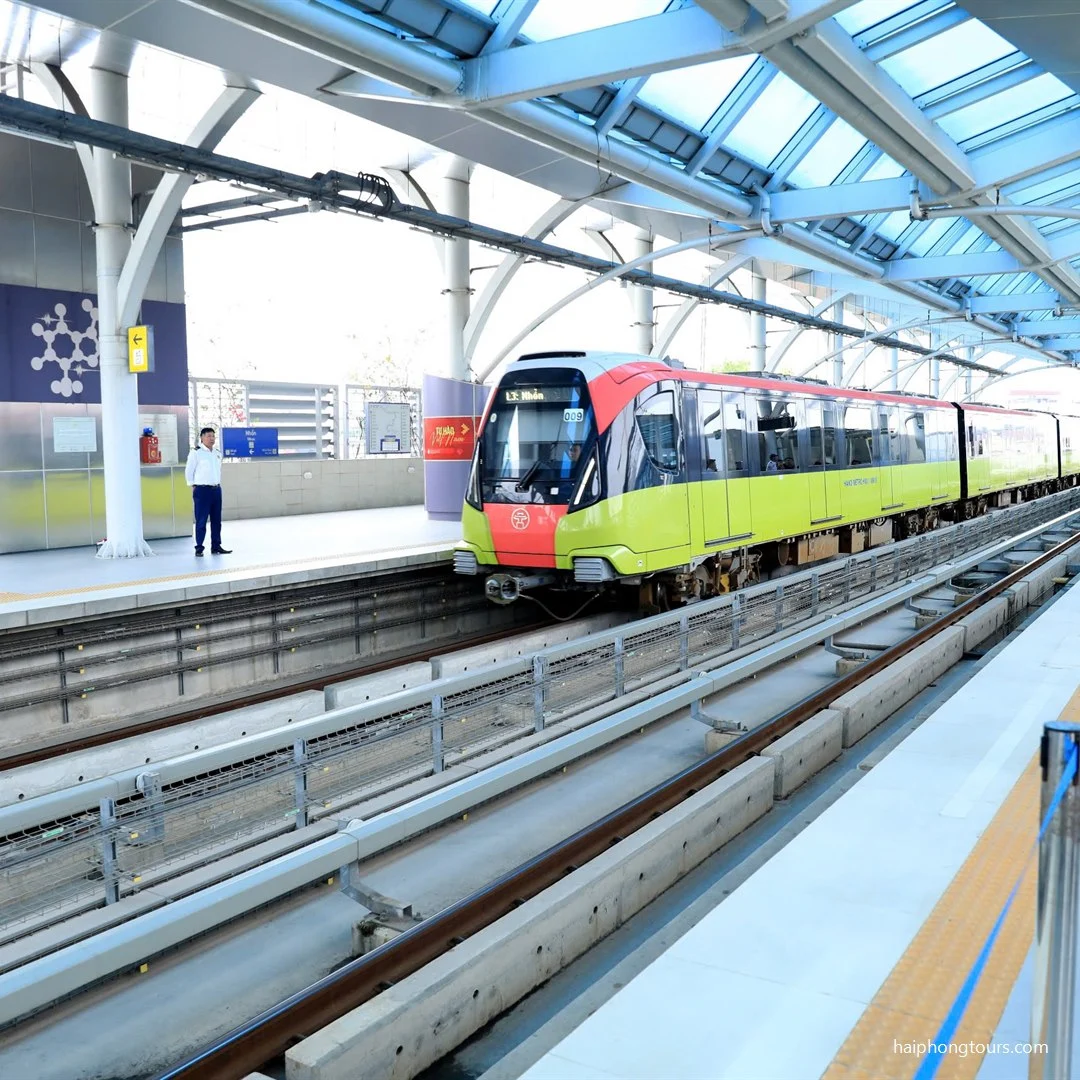
Cau Giay is the eastern endpoint of the elevated Line 3 section now open to passengers. The operating section runs between Cau Giay and Nhon through eight elevated stations. The underground extension toward central Hanoi and Hanoi Railway Station is not part of current passenger service.
That distinction changes the whole route. There is no metro platform to enter at Hanoi Railway Station and no direct Line 3 ride to Cau Giay. A future project target is not an opening notice. The route must remain a road or surface connection until the operator announces passenger service and the journey is checked again.
At Cau Giay, use the signed operating entrance. Do not invent an exit number, assume a lift is working or ask a driver to stop at a broad district pin. A photograph of the entrance and a live location are more reliable than an old route description.
Choose between a direct ride and public transport
A recorded taxi or licensed car removes the need to interpret changing city stops after a train journey. It is useful for a group, large luggage, limited mobility, rain, late arrival or a fixed commitment after the metro. Confirm the Hanoi station pickup side and the exact Cau Giay entrance in writing.

A surface public route may suit a traveler with light luggage and no hard deadline. Check the current origin stop, direction, transfer points, destination stop and final walk. Do not freeze a bus number into an evergreen plan, because urban routes and stop arrangements can change.
If the verified public route ends far from the station entrance or requires awkward stairs with luggage, compare the whole trip rather than the fare alone. A short recorded ride can be the more practical option even for someone who intends to continue by metro.
Allow for a real station handoff
The national train, city route and metro are separate services. A late train does not hold a bus or extend metro hours. Add time for rail release, the city journey, the walk to the signed entrance and fare control at Cau Giay.
Late in the day, decide whether reaching the metro still helps. If Line 3 is close to closing, travel directly to your final accommodation instead of paying for a ride to Cau Giay and then discovering the remaining metro journey is no longer practical.
Hai Phong Tours recommends making that decision at the railway exit, after the actual arrival is known. It is more useful than preserving a transfer plan that depended on an on-time train and an assumed station entrance.
Handle bags and mobility before moving
Keep tickets, identity documents, medicine and electronics in hand luggage. Count every bag on the platform, at the station exit and again before the road vehicle leaves. A missing item is easier to report while you are still inside the staffed rail facility.
Travelers who need step-free access should confirm the usable pickup and metro entrance on the day. Do not assume that the nearest entrance has an operating lift. A direct vehicle to the final destination may be more sensible if the accessible route cannot be confirmed.
When booking a car, state the number and size of bags. A small vehicle that cannot safely carry the group creates a new delay at exactly the point where the metro operating margin may already be shrinking.
Recover without unsafe rushing
If the inbound train is late, recalculate from the actual exit time. When the metro window is no longer comfortable, continue by recorded road vehicle to the final address or stay in central Hanoi. Do not ask a driver to speed simply to complete the planned metro transfer.
If the vehicle arrives on the wrong station side, stay at a staffed public point and resend the correct Le Duan or Tran Quy Cap location. If you reach Cau Giay but the intended entrance is closed or inaccessible, follow current station signs and ask metro staff for the operating entrance.
A city delay on this journey is not a protected railway connection, and the railway does not compensate for a missed metro. Each operator deals only with its own service. That is why the plan needs a road fallback that takes you somewhere useful, not merely to the next transfer point.
Final checks before leaving the railway station
- Confirm the actual Le Duan or Tran Quy Cap release side.
- Check that elevated Line 3 service between Cau Giay and Nhon is operating.
- Verify the complete surface route or record the direct vehicle booking.
- Confirm the signed Cau Giay entrance, fare method, luggage rules and accessibility.
- Travel directly to the final destination if the metro stage no longer adds value.
The key fact is simple: Hanoi Railway Station and Cau Giay Metro Station are not connected by an operating metro ride. Once that is clear, the journey becomes easier to plan honestly. Start from the real rail exit, choose a complete surface route and keep a useful direct-road fallback.
Useful guides for your trip
Would a private transfer make this journey easier? Contact us with your travel date, exact pickup and drop-off, number of travelers and bags. Include any flight, train or cruise deadline so we can assess a suitable plan and quotation.