
Hanoi Opera House is currently an exterior architecture stop, not an available interior sightseeing visit. The theatre closed after 31 January 2026 for restoration, conservation and upgrading, with the work expected to take about two years. That is an estimated duration, not a confirmed reopening date. You can plan a walk around the surrounding public streets, subject to construction barriers, but should not buy an old tour listing expecting entry.
The building stands at 1A Trang Tien on August Revolution Square, southeast of Hoan Kiem Lake. Even during the closure, its position helps explain this part of Hanoi: broad streets, a formal civic frontage and a different urban scale from the Old Quarter’s narrow commercial lanes.

What can visitors do during the restoration?
| Activity | How to plan it |
|---|---|
| View the exterior | Use open public pavements and respect any worksite barriers; views may be partially obstructed |
| Visit the auditorium or grand interior | Do not include this while the restoration closure remains in force |
| Buy a performance ticket | Read the exact venue address; a Hanoi concert is not necessarily at this building |
| Join a city sightseeing bus | A stop named Opera House is a transport location, not proof that the theatre is open |
| Photograph the square | Stay on a suitable public pavement rather than stepping into the traffic for a central angle |
Allow around 20 to 30 minutes for a short exterior stop if you are already walking in the area. This is a suggested allocation, not an official tour duration. If scaffolding or barriers substantially limit the view, continue your neighborhood walk rather than waiting for access that is not being offered.
The restoration notice from the National Archives Centre I explicitly says visitors cannot directly tour the historic building during the work. Older articles describing interior tours, package prices or daily tour hours relate to a different access situation. A future reopening should be established by a new announcement, not calculated by simply adding two years to the closure date.
Why the Opera House matters
The theatre was designed by French architects including Broyer, V. Harlay and F. Lagisquet, with construction and completion taking place between 1901 and 1911. It formed part of the colonial transformation of Hanoi’s public spaces. The building was intended to carry cultural and civic prestige as well as accommodate performances.
The National Archives’ account records construction beginning on 7 June 1901 after the April tender. The site included a recently filled pond, requiring substantial foundation work. About 35,000 bamboo piles were used before the concrete foundation was laid. That hidden engineering is a useful counterpoint to the finished building’s formal appearance.
The theatre’s later role extends beyond performance history. Hanoi’s municipal tourism account records the first session of Vietnam’s National Assembly here on 2 March 1946. Its association with the capital therefore includes both the colonial city and the political history of modern Vietnam.
How to look at the architecture from outside
Start with the overall composition
From an open public viewpoint, take in the building as a whole before concentrating on decoration. Notice the strong central entrance, the balanced frontage and the way the theatre addresses the square. Its position at the end of a street view is part of the design’s effect.
Compare that composition with the smaller, changing shopfronts closer to Hoan Kiem Lake. The difference helps explain why this area feels distinct even though the walking distance from the lake is manageable. You are moving between different periods and approaches to city building.
Look for details without entering restricted areas
When the worksite arrangement allows a clear view, study the columns, upper openings and roofline from the pavement. A longer camera lens can isolate a detail without requiring you to cross a barrier or occupy the middle of the square.
The historic building includes public front-of-house spaces, an auditorium and extensive backstage functions. During the closure, treat archive photographs and architectural explanations as context for those interiors, not as a description of rooms you can currently walk through.
A useful walk from Hoan Kiem Lake
Begin at the southern end of the lake and continue along Trang Tien toward the Opera House. Keep the route flexible enough for a drink or a shop stop. At the theatre, pause where the public pavement offers a view, then choose your return according to time and energy.
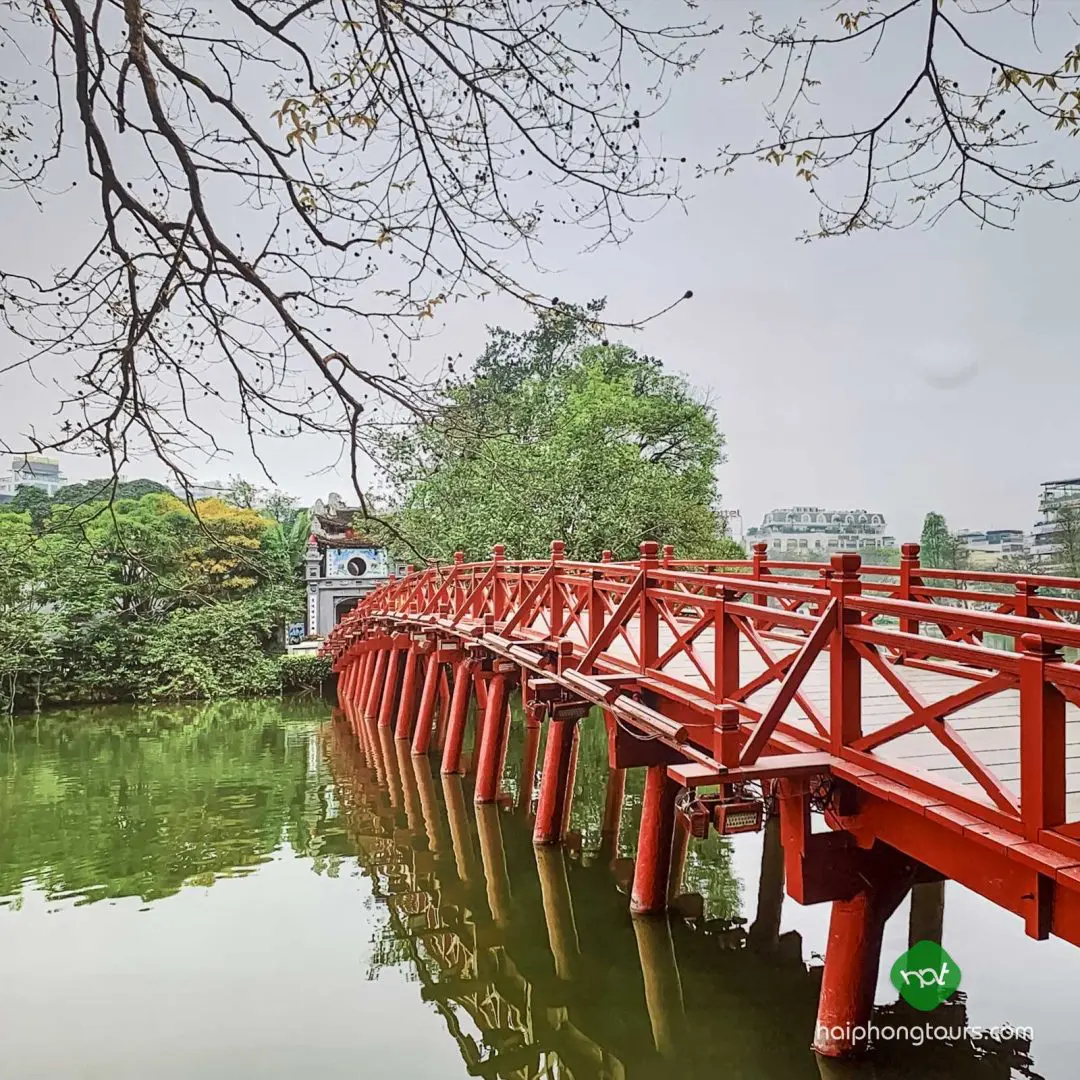
For a longer cultural walk, visit Ngoc Son Temple earlier in the day, then follow the lakeside toward Trang Tien. The temple and theatre give you two contrasting architectural settings without requiring a car between every stop.
If you prefer an overview from a vehicle, our Hanoi sightseeing bus guide explains the operators and ticket choices. Some city-tour boarding arrangements use the Opera House area when lakeside streets are pedestrianized. Confirm the bus operator’s actual departure point rather than assuming that the theatre entrance is the meeting place.
How to choose a performance elsewhere in Hanoi
If an evening performance is the reason you searched for Hanoi Opera House, begin with the event rather than the landmark. Compare the performance type, date, language or surtitles, duration and precise venue. Ho Guom Opera and Hanoi Opera House are different venues; similarly named search results can lead to the wrong address.
- Choose a performance and find the organizer’s current event announcement.
- Match the venue name and street address to the ticket page.
- Read the seat category and admission conditions before paying.
- Arrange dinner and transport around the actual performance venue.
- Keep the issued ticket available offline and follow the organizer’s arrival instructions.
Do not assume that all concerts described as “opera house concerts in Hanoi” take place at 1A Trang Tien. If a seller still advertises an interior tour of the closed building, obtain a clear explanation of the present access before purchasing.
Is the exterior worth a stop?
It is a worthwhile addition to a walk through the Trang Tien area, particularly if architecture interests you. It is less suitable as the sole reason for a long cross-city journey during the restoration. Pairing the exterior with the lake, a meal and another open cultural attraction makes the time more useful.
For help arranging transport around an actual performance, an airport arrival or an onward northern Vietnam journey, contact Hai Phong Tours with the event’s address and timing.